
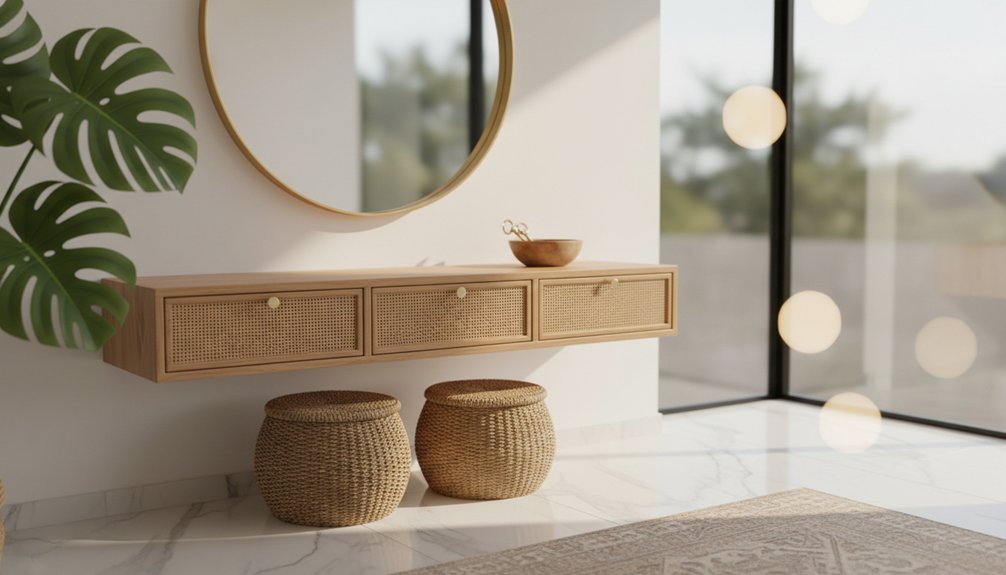
Before you select hallway storage furniture, measure your hallway to ensure you maintain at least 36 inches of clear walking space. Start by choosing multi-functional pieces such as storage benches that feature hidden compartments for shoes and seasonal items. Next, add wall-mounted hooks to take advantage of vertical space without obstructing the floor area. For narrow hallways, opt for slim cabinets that fit well without crowding the space. Shoe cubbies will help you organize pairs and make them easily accessible.
Choose solid wood construction for durability instead of particleboard, as solid wood will last longer under regular use. Select furniture that matches your existing color palette to create a cohesive look at your entrance.
In the upcoming sections, I will provide specific combinations that work effectively for hallway storage and highlight common mistakes to avoid for optimal organization.
Measure Your Hallway Before Buying Storage Furniture
Before purchasing hallway storage furniture, measure your hallway accurately. Measure the width, length, and height of your hallway to capture the exact dimensions. Also, measure doorways and any obstacles that may affect where you can place furniture. Write down these measurements and keep them accessible while shopping.
Knowing your hallway dimensions helps you select suitable furniture styles that fit well without causing congestion. For narrow hallways, opt for slim, wall-mounted storage solutions. In contrast, wider hallways can accommodate benches with built-in storage.
Additionally, measure the dimensions of the furniture you plan to buy. Aim to leave at least 36 inches of walking space to ensure easy passage. Taking these precise measurements helps avoid costly mistakes and returns. To maximize functionality, consider using multi-functional items such as storage benches that can serve as seating.
Smart Shoe Storage Ideas for Hallway Floors
To effectively manage shoe storage in your hallway, start by selecting the right furniture size for your space. Once you have that, focus on organizing shoes to prevent clutter on the floor.
Shoe cubbies provide designated places for each pair, making them a practical solution. You can choose from various configurations, including stackable cubbies or bench-style units that double as seating. Open cubbies allow for easy access to shoes, while closed compartments help conceal mess.
For a more flexible storage option, consider decorative baskets. Baskets can hold shoes and be placed along the wall or beneath a console table. Woven rattan or wire baskets work well in casual settings, while fabric-lined baskets fit better in formal entryways. Both options keep shoes organized and reduce the risk of tripping.
When deciding between cubbies and baskets, assess your hallway’s available space and your personal style. If you frequently use multiple pairs of shoes, opt for open cubbies for quicker retrieval.
If aesthetics are a priority, choose baskets that match your decor while still being functional. Prioritize solutions that keep your hallway tidy and accessible. Additionally, selecting furniture made from solid wood materials ensures durability and enhances the overall aesthetic of your entryway.
Hallway Storage Benches With Hidden Compartments
When you need seating and storage in a narrow hallway, choose benches with hidden compartments. These benches feature lift-up seats that provide ample space for storing shoes, scarves, and seasonal items.
You can find various styles, including upholstered benches with tufted tops and wooden benches with clean lines. The hidden storage keeps your hallway organized while offering a comfortable place to sit when putting on shoes.
Select benches equipped with soft-close hinges to prevent the lid from slamming, which helps protect your fingers. If multiple family members will use the bench at once, check the weight capacity to ensure it can support everyone comfortably.
Measure your hallway width carefully, as most benches range from 36 to 60 inches long. This type of furniture maximizes your hallway space without compromising functionality. Incorporating traditional styles can add a touch of elegance and sophistication to your hallway design.
Wall-Mounted Hooks and Racks for Coats and Bags
Wall-mounted hooks and racks provide efficient storage solutions for coats and bags in vertical hallway spaces. These fixtures maximize limited floor space and keep essential items accessible. They come in various materials such as wood, metal, and modern composites, allowing homeowners to align them with their existing décor.
Wall-mounted storage transforms narrow hallways into organized spaces while complementing your home’s design through versatile material choices.
Effective coat organization prevents clutter on furniture surfaces, while dedicated bag storage ensures items remain off the floor.
Different Hook Types Serve Specific Needs
- Single Hooks hold individual coats and bags. These hooks require screws or anchors for secure installation.
- Multi-Peg Rails accommodate multiple family members. Install these on wall studs for maximum stability.
- Fold-Down Hooks save space in tight areas. Use toggle bolts for reliable installation.
- Decorative Racks enhance the aesthetic of style-conscious homes. Professional mounting is recommended for safety and durability.
Install hooks at appropriate heights for both adults and children to ensure everyone can manage their belongings independently.
Avoid placing hooks too high or too low to prevent accessibility issues. Remember to consider the weight capacity of each hook type to prevent damage and ensure safety.
Slim Hallway Cabinets That Hide Clutter
Slim hallway cabinets provide efficient vertical storage solutions that utilize wall space from floor to ceiling while preserving essential floor area.
These cabinets feature multi-functional designs that include closed storage compartments for shoes and bags, alongside open shelving for items like keys and mail. By keeping clutter concealed behind cabinet doors, these units ensure that everyday essentials remain easily accessible for quick departures.
When selecting a slim hallway cabinet, consider dimensions that fit your specific hallway measurements, ensuring the cabinet doesn’t obstruct movement. Look for options with adjustable shelves to customize storage for various items. Additionally, choose materials that match your home decor while providing durability for daily use.
Slim hallway cabinets can also come with limitations. For instance, some designs may not offer enough depth for larger bags or bulky shoes. Assess your storage needs to avoid purchasing a cabinet that doesn’t accommodate your items.
For practical application, measure your hallway space before shopping for a cabinet. Ensure that the cabinet’s height and width fit your area while also leaving room for door clearance and foot traffic.
Vertical Storage Solutions Available
Homeowners often face challenges with limited floor space in their hallways. Vertical storage solutions offer a practical approach to making the most of that available space. By installing vertical shelving units that reach from the floor to the ceiling, homeowners can create multiple levels of storage without sacrificing valuable floor area.
Corner units can effectively utilize unused angles and turn them into functional storage areas.
Types of Vertical Storage Solutions
- Wall-mounted shelves: These shelves range from 4 to 8 feet in height and provide low to medium storage capacity. Homeowners can use them to store decorative items or everyday essentials like keys.
- Tall cabinets: With heights from 6 to 8 feet, tall cabinets offer high storage capacity. These cabinets are ideal for storing items such as shoes and cleaning supplies.
- Corner units: Standing between 5 and 7 feet tall, corner units provide medium storage capacity. They fit well in awkward spaces, making them great for maximizing corner areas.
- Ladder shelves: Ranging from 5 to 6 feet in height, ladder shelves have a medium storage capacity. They work well for displaying books, plants, or baskets.
These vertical storage options effectively accommodate various items, helping maintain an organized and clutter-free entrance area.
Prioritizing vertical solutions can significantly enhance the functionality of narrow hallways or limited entry spaces.
Multi-Functional Cabinet Designs
Multi-functional cabinets provide efficient hallway organization, especially where floor space is limited. These cabinets combine shoe storage at the bottom, drawers in the middle, and hooks at the top for coats and bags. This design maximizes wall space and reduces clutter in entryways.
Modern manufacturers integrate practical features into these cabinets. For example, pull-out umbrella holders allow users to store umbrellas neatly, while built-in charging stations provide convenient power access for devices.
Adjustable shelving systems enable customization for different storage needs. Some cabinets include mirrored doors, offering storage and a quick check of one’s appearance before leaving home. Sliding doors efficiently utilize narrow hallways, avoiding the obstruction common with traditional swinging doors. These features transform standard cabinets into comprehensive organizational systems.
Limitations exist, such as the need for adequate wall support for heavy cabinets. Some designs may not fit in extremely tight spaces, reducing their effectiveness.
Choosing the right cabinet requires considering both the available space and the specific storage needs.
Multi-Functional Hallway Furniture for Narrow Spaces
When designing furniture for narrow hallways, prioritize multi-functional pieces that conserve floor space. Wall-mounted storage solutions provide organized storage for essentials while keeping the floor area clear. For example, a wall-mounted shelf can hold keys and mail, preventing clutter on the floor.
In addition, consider slim benches with built-in storage compartments. These benches offer a place to sit while also providing concealed space for shoes, bags, and seasonal items. A bench that’s 48 inches long and 15 inches wide can fit comfortably in limited space while maximizing utility.
Limitations of traditional bulky furniture become apparent in narrow hallways. Avoid oversized cabinets or wide benches, as they obstruct movement and create congestion. Instead, focus on sleek designs that integrate seamlessly into the hallway layout.
Wall-Mounted Storage Solutions
Narrow hallways often lack the floor space needed for traditional furniture. Wall-mounted storage solutions effectively maximize vertical space without creating obstructions. Wall-mounted shelves provide essential storage for keys, mail, and decorative items, ensuring that surfaces remain accessible. Hanging organizers, such as hooks and rail systems, efficiently store coats, bags, and umbrellas.
Consider these specific wall-mounted options for your hallway:
- Floating shelves with hooks: These units combine display space above with practical hanging points below. You can store everyday items like keys and bags within easy reach.
- Modular cube systems: These customizable compartments adapt to your changing storage needs. You can reconfigure them as necessary to accommodate different items over time.
- Fold-down desks or tables: These surfaces create temporary workspaces that fold away when not in use. They’re ideal for small areas where a permanent desk would consume too much space.
These wall-mounted solutions keep your hallway functional and organized while maintaining valuable floor space. Each option enhances accessibility and efficiency in a narrow corridor.
Slim Benches With Storage
Slim benches with built-in storage compartments effectively meet the dual needs of seating and storage in narrow hallways. These benches typically measure between 12 to 18 inches in depth, making them suitable for tight spaces.
Many models feature lift-up seats that provide hidden compartments for storing items like shoes, umbrellas, and seasonal accessories. For easy access to frequently used items, some benches include open cubbies beneath the seating area.
When choosing a slim storage bench, prioritize models with cushioned tops for comfort while putting on shoes. Additionally, look for benches that include hooks or shelves mounted above to further utilize vertical space.
Selecting benches made from durable materials, such as solid wood or metal frames, ensures longevity and functionality. Finally, choose finishes that complement the existing décor of your hallway to create a cohesive look.
Why Solid Wood Hallway Storage Outlasts Particleboard
Solid wood furniture consistently outlasts particleboard in hallway storage solutions. Solid wood withstands daily use for decades, while particleboard shows wear and limitations within a few years.
Key differences that matter:
1. Moisture resistance: Solid wood tolerates humidity without deteriorating. It expands and contracts naturally, keeping its integrity intact.
In contrast, particleboard swells and crumbles when exposed to moisture, leading to structural failure over time.
2. Weight capacity: Solid wood supports heavier items, such as coats and storage bins, without sagging. Its robust construction ensures that it can handle the demands of daily use.
Particleboard, however, struggles under similar weight, often leading to bending or breakage.
3. Repair potential: When solid wood gets scratched or dented, it can be sanded down and refinished, restoring its original appearance.
Particleboard damage, however, is permanent, as the material can’t be repaired once it’s compromised.
Your hallway furniture experiences constant traffic, making the choice of material crucial for long-term functionality.
Opting for solid wood ensures durability and longevity, while particleboard may require replacement sooner than you anticipate.
Best Hallway Storage Combinations for Small Entryways
To create a functional storage system in narrow entryways, focus on three key pieces: a wall-mounted coat rack, a slim bench with hidden storage, and a vertical shoe cabinet.
First, install the wall-mounted coat rack at eye level to optimize vertical space and keep the floor clear for easy movement.
Maximize your narrow entryway by mounting the coat rack at eye level, freeing up valuable floor space for better traffic flow.
Next, choose a slim bench that doesn’t exceed 14 inches in depth. This depth allows for comfortable seating while ensuring the walkway remains accessible. Select designs that have minimal visual clutter, as this helps maintain a clean look in tight spaces.
For footwear storage, opt for a vertical shoe cabinet that measures only 6-8 inches deep. This depth allows you to store shoes upright, making it easier to see and access them while keeping the area organized.
Consider adding a small mirror above the coat rack. The mirror enhances the sense of space in the entryway.
Together, these three pieces—coat rack, slim bench, and vertical shoe cabinet—work efficiently to create a streamlined and practical entryway without overwhelming the limited area.
Common Hallway Storage Mistakes to Avoid
When planning hallway storage, many homeowners make the mistake of choosing furniture that’s too large for their space. This choice creates cramped conditions that block foot traffic. Overstuffed furniture makes narrow hallways feel claustrophobic and reduces overall functionality.
To avoid these common mistakes, follow these guidelines:
- Measure Your Hallway – Always measure your hallway dimensions before buying storage items to ensure a proper fit. For example, if your hallway is 3 feet wide, select storage pieces that are no wider than 2 feet to maintain adequate walking space.
- Consider Design Aesthetics – Choose storage solutions that not only meet your storage needs but also complement your home’s design style and color palette. For instance, if your home features a modern aesthetic, opt for sleek, minimalistic storage options rather than bulky, traditional pieces.
- Position for Natural Light – Avoid placing tall storage units near windows or light sources. This placement can darken your entryway and make the space feel less inviting. Instead, use low-profile shelves or cabinets that allow light to flow through.
By selecting appropriately sized storage pieces that balance functionality with visual appeal, you create a welcoming and organized entrance.
This approach maintains both comfort and style in your hallway.