

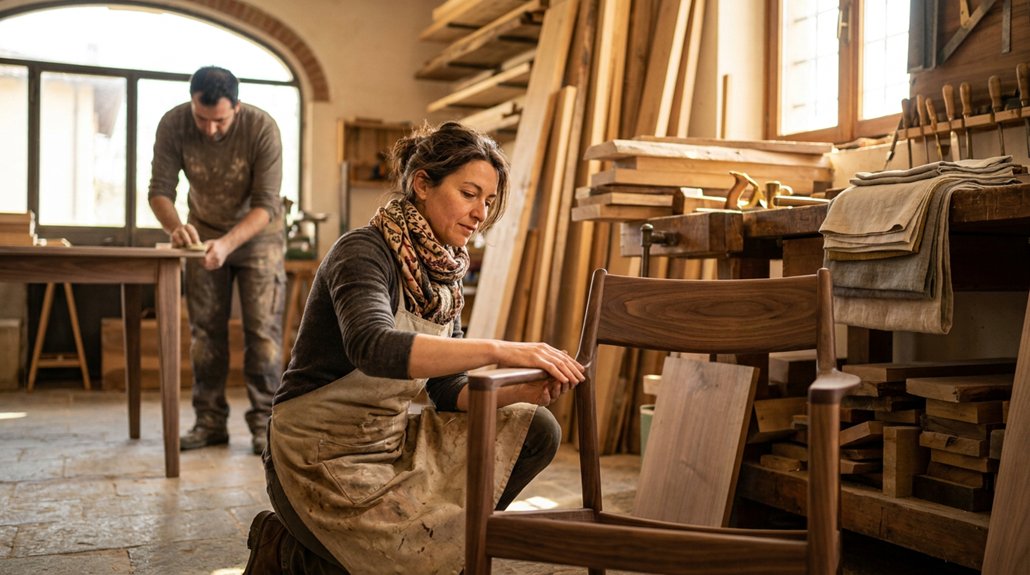
European interior designers are switching to direct furniture sourcing because buying from the factory removes three layers of markup (importer, distributor, retailer) and saves 20-30% on mid-sized projects. Retail prices run 2-3 times the factory price. That saving holds after freight, import duties, and agent or inspection fees. Direct sourcing also lets designers specify the wood species, foam density, finish, and exact dimensions, and approve a physical sample before production starts.
Direct sourcing does not suit every project. Small orders lose most of the saving to per-container freight and minimum order quantities. Projects with tight install dates cannot absorb the weeks added by sample rounds, production, and shipping. Designers also take on the work that a retailer normally handles, including customs paperwork, damage claims, and warranty disputes with the factory.
The sections below show which project sizes and product categories produce the savings, which ones do not, and how to vet a factory before paying a deposit.
What Is Direct Furniture Sourcing?
Direct furniture sourcing means we buy furniture from the factory or workshop that builds it, with no importer, distributor, or showroom between us and the maker. The traditional trade model adds four layers: manufacturer, importer, distributor, and showroom. Each layer adds a markup, so retail prices usually land at two to three times factory cost. A sofa priced at $900 FOB at the factory often reaches the client at $2,000 to $2,700.
In direct furniture sourcing, we negotiate every specification with the factory: wood species, foam density, fabric, finish, and dimensions. We book freight, usually a 40-foot container, and we handle customs paperwork. We also arrange compliance testing, such as TB117-2021 flammability for upholstery and CARB Phase 2 formaldehyde limits for composite wood sold in the US.
Direct furniture sourcing also shows you the cost structure. A factory quote lists materials, labor, packing, and freight as separate lines, so you can compare each line across two or three factories and see which one charges more for the same oak frame. Production schedules also become predictable. A typical order runs 8 to 12 weeks in production plus 4 to 6 weeks of ocean freight from Asia, and we inspect at three points: raw materials, pre-finish assembly, and pre-shipment. Designers know the landed cost before they quote the client, which protects project margins.
When we inspect pre-finish assembly, we check that the factory uses mortise-and-tenon joints for chair and table frames and dovetail joints for drawers, since both indicate high-quality solid wood construction.
Direct furniture sourcing doesn’t suit every project. Factories usually set minimum order quantities, often 20 to 50 pieces per style or one full container, and they require a 30% deposit at order with the balance due before shipment. Projects under 10 to 15 pieces, or projects that need delivery in under 8 weeks, usually fit stock furniture from a trade vendor better.
We also carry the risk that a showroom would otherwise absorb. Transit damage, customs delays, and production defects become our responsibility, and we resolve them with the factory directly.
Why Are European Designers Skipping Middlemen?
European designers buy directly from workshops because direct sourcing removes two to three layers of margin, gives them control over specifications, and shortens lead times by several weeks. Retail prices after an importer, a distributor, and a showroom typically reach two to three times the factory price. This article covers cost, specification control, quality inspection, and lead time, and it states where direct sourcing doesn’t work.
Direct sourcing removes two to three layers of margin, and retail prices after intermediaries typically reach two to three times the factory price.
Direct sourcing removes importer, distributor, and showroom margins
Designers who order directly pay the workshop price plus freight, and they skip three separate markups. A sofa that costs €900 at a Polish factory sells for roughly €1,800 to €2,700 once the importer, distributor, and showroom add their margins. A designer who buys that sofa directly adds freight (often €80 to €150 per piece on a shared pallet) and a project fee, then either lowers the client price or keeps the difference as profit.
Direct sourcing shifts costs and risks to the designer. The designer arranges customs paperwork for non-EU clients, pays import duty where it applies, and files damage claims with the carrier. On a single-piece order, these tasks can erase much of the margin gain.
Designers control materials, finishes, and dimensions when they order from the workshop
A designer who contacts the workshop specifies materials, finishes, and dimensions without the limits of a catalog. Workshops in Poland, Portugal, and Italy change a seat height from 45 cm to 48 cm, switch a lacquered finish to hard-wax oil on oak, or cut a table to 2,300 mm instead of the standard 2,000 mm. Designers who customize a dining table this way should still leave at least 36 inches between the table edge and walls or furniture so guests can move comfortably.
Through an importer, custom work often requires a minimum order of 20 to 50 units. Direct orders for custom pieces are often accepted at 1 to 10 units, usually with a 10% to 20% surcharge.
Workshops still set their own minimums on inputs. Upholstery fabric usually ships in 50 m rolls, and lacquer is mixed in fixed batches, so a single custom color can raise the unit price.
Designers verify quality by inspecting samples and visiting factories
Designers who deal with the workshop directly inspect samples, approve prototypes, and check production without a third party filtering the information. The inspection covers joint tolerances, foam density, edge radii, and finish thickness. The designer receives the workshop’s answers firsthand, with no importer relaying them.
A factory visit costs roughly €400 to €800 in travel for one person, which a €5,000 order can’t justify. For smaller orders, designers hire an independent inspector at about €250 to €400 per day, or they approve a single paid prototype and photograph the production run before shipment.
Direct sourcing shortens lead times by removing handoffs
Each handoff between importer, distributor, and showroom adds a stock check, an order consolidation, or a shipping delay. A direct order goes from the designer to the workshop, so production takes 6 to 10 weeks and freight takes 1 to 2 weeks. The same custom piece through intermediaries often takes 12 to 16 weeks.
Direct sourcing loses to a local importer when the importer holds the item in stock. A showroom piece can reach a client within days, while a direct order cannot. Importers also handle returns and warranty claims.
With a direct order, the designer negotiates those claims with the workshop, so the designer must confirm warranty terms in writing before production starts.
How Much Does Direct Sourcing Really Save?
Direct sourcing saves 15% to 50% of the retail price before fees. On a mid-sized residential project, the net savings after all fees are usually 20% to 30%. Order size, product category, and the party who handles logistics determine where a project falls in that range.
This article lists the savings by category, the added costs, and the landed cost comparison that produces the net figure.
Savings by Product Category
Direct sourcing cuts the price of upholstery and case goods by 30% to 50% against retail. The manufacturer’s margin replaces the markups of two or three distributors, so the buyer pays one margin instead of three. Traditional pieces such as Queen Anne and Chippendale furniture are built from solid hardwoods like oak, cherry, and mahogany, so material and labor make up a large share of their factory cost.
Lighting and decor save 15% to 25%. Certification testing and shipping add cost to these products and shrink the gap between the factory price and the retail price. Small orders in any category fall near the bottom of the range.
Added Costs of Direct Sourcing
Direct sourcing adds freight, customs duties, and import VAT, which together raise the factory price by 10% to 20%. The buyer also takes on the risk of damaged goods in transit.
On a retail purchase, the retailer carries that risk. We add cargo insurance and a replacement allowance for damaged pieces to every direct-sourced budget.
Minimum Order Quantities and Shipment Consolidation
Minimum order quantities set the smallest order a factory accepts, and consolidating shipments across several clients cuts per-unit freight sharply. Consolidation works only when delivery windows match.
A client with a fixed installation date can’t wait for other clients’ orders to fill a container, so that client pays full freight rates.
Landed Cost Comparison
Landed cost is the figure to compare against the retail quote. Landed cost equals the factory price plus freight, customs duties, import VAT, insurance, and the damage allowance. Factory price alone overstates the savings.
After all fees, we usually net 20% to 30% on a mid-sized residential project. Direct sourcing doesn’t pay off on small orders, because fixed freight and handling fees outweigh the margin difference.
What Can You Customize When Buying Direct?
What Can You Customize When Buying Direct?
Direct buying lets designers customize materials, finishes, and dimensions, because workshops accept specification orders without a distributor in between. Custom materials start at 20 to 50 units per order. Each custom finish costs €150 to €500 in one-time setup. Dimension changes usually carry little or no surcharge. Custom work adds two to four weeks to lead time.
Which Materials Can Designers Specify Direct?
Designers specify timber species, veneer grades, leather hides, and fabric composites directly with the workshop. Many European workshops accept minimum orders of 20 to 50 units for custom materials. Wholesalers usually require 200 or more units for the same specification.
Each workshop sets its own minimum, so we confirm the number in writing before we commit a client to a material.
Which Finishes Can Workshops Match?
Workshops match custom stains, lacquer sheens, powder-coat colors, and brass patinas to a client’s sample. The factory charges a one-time setup fee of €150 to €500 per finish.
The factory then stores the finish formula and applies the same formula to repeat orders. We send a physical sample, because a screen color or printed swatch produces a mismatch. We also approve one finished piece before the factory starts the full run.
Which Dimensions Can Workshops Change?
Workshops adjust seat heights, sofa depths, and table lengths at little or no surcharge. We send the revised dimensions with the first drawing, so the workshop can check each change against the frame construction before quoting.
How Much Time Does Customization Add?
Custom work adds two to four weeks to the standard lead time. We add this buffer to every project schedule before we give the client a delivery date.
How Do You Find and Vet Furniture Makers?
How Do You Find and Vet Furniture Makers?
Finding and vetting a furniture maker takes four steps: sourcing candidates, verifying the business, assessing a paid sample, and inspecting the workshop. We shortlist three to five workshops from trade fairs, craft associations, and designer referrals. We then verify registrations, certificates, and finances.
We test one paid sample per workshop against measurable thresholds: 8 to 12 percent moisture content and at least 90 percent on-time delivery. A workshop that fails any step leaves the shortlist.
Where Do You Find Furniture Makers Worth Trusting?
We find workshops through trade fairs, regional craft associations, and designer referrals.
- Trade fairs: We visit Salone del Mobile and Maison&Objet to inspect joinery on the booth. A fair booth shows a maker’s best pieces, so we treat the visit as a screening step and not as proof of production quality.
- Craft associations: We cross-check each maker against regional craft associations in Portugal, Poland, and Italy. Membership confirms the workshop operates locally. Membership doesn’t confirm quality.
- Designer referrals: We ask fellow designers for introductions. Referrals convert into working relationships more often than fair contacts or directory listings, so we request them first.
How Do You Verify a Furniture Supplier?
We verify a supplier by checking legal status, certification, export history, and financial health.
- Registration: We request the business registration and VAT number. We confirm the VAT number in the official EU VIES database.
- Certification: We request FSC or PEFC certificates and check the certificate code in the issuing body’s public database. Expired and mismatched certificates appear regularly.
- Export history: We confirm exports through customs records or direct references from two previous export clients. Customs records aren’t available in every country, so client references serve as the fallback.
- Finances: We review the workshop’s financial statements. A workshop with thin margins can’t absorb a timber price increase, and the cost lands on our order or stalls production.
How Do You Assess a Furniture Maker’s Quality?
We assess quality by ordering one paid sample and measuring the result.
- Tolerances: We measure joint gaps, squareness, and dimensions against the drawing with calipers and a steel rule.
- Finish: We run an abrasion test on the finished surface and inspect the result for wear-through.
- Moisture content: We check boards with a pin-type moisture meter. Kiln-dried hardwood should read 8 to 12 percent. For pieces going into centrally heated interiors, we require the lower end of that range.
- Lead time: We compare quoted dates with delivered dates across the workshop’s recent orders. Reliable makers deliver on the quoted date at least 90 percent of the time.
A free sample doesn’t substitute for a paid sample. A maker produces a free sample with extra care, so the result doesn’t represent standard production.
How Do You Confirm a Workshop in Person?
We confirm the workshop by visiting the site or scheduling a live video walkthrough as the final step.
During the visit, we inspect the lumber storage, the machine condition, the finishing room, and the dust extraction.
A video walkthrough covers the same areas but can’t show moisture levels or finish quality in detail. We therefore ask the maker to point the camera at the moisture meter readings and at finished panels under raking light.
When Is Direct Sourcing Not Worth It?
When Is Direct Sourcing Not Worth It?
We skip direct sourcing when the furniture budget is below roughly €15,000, the schedule is tight, or the order volume is small. Vetting a workshop costs us staff time and travel money, and a small order cannot repay that cost. Below €15,000, wholesale or showroom purchasing usually wins.
| Scenario | Direct Sourcing | Showroom Purchase |
|---|---|---|
| Under €15,000 | Rarely worthwhile | Usually better |
| €15,000 to €50,000 | Decide case by case | Decide case by case |
| Over €50,000 | Strong savings | Higher markup |
Direct Sourcing Adds Logistics Work
When we source direct, we coordinate freight, customs, and damage claims ourselves. One delayed container can stall an installation by several weeks. Tight deadlines cannot absorb that delay, so on those projects we buy in-stock pieces from showrooms.
Workshops Limit Design Flexibility
Workshops lock custom pieces in once production starts. A late client change to a finish, dimension, or fabric then costs extra money or becomes impossible. Showrooms let us swap finishes or substitute items within days.
When We Still Choose Direct Sourcing
We choose direct sourcing only when volume, schedule, and design certainty together justify the vetting cost. Projects above €50,000 usually meet that standard, because the savings outweigh the markup a showroom adds. If any one of those three conditions is missing, we buy from established suppliers and protect our margins.