

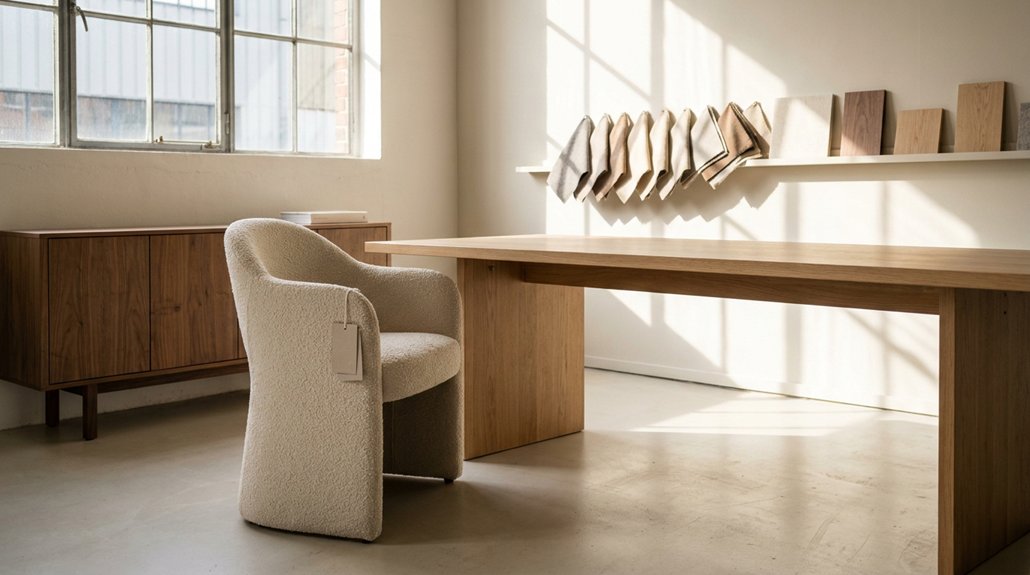
White label furniture lets a brand sell EU-made pieces under its own name while a contract factory handles production. We select designs from the factory’s catalogue, change finishes or fabrics, and run sales and customer service ourselves. Factories set minimum order quantities of 20-300 units per model, and production takes four to sixteen weeks after order confirmation. A finish change on an existing frame sits at the low end of both ranges. Custom upholstery or new hardware sits at the high end.
Our brand name on the product makes us the legal manufacturer under EU product safety law. We vet each supplier, check every test certificate against the exact model and fabric we order, and keep a technical file for each product. A certificate issued for a different model or an older fabric does not cover our product, so we reject it and request new testing. The sections below cover trademark registration and supplier contract terms.
How Does White Label Furniture Work?
White label furniture works through a division of labor: a manufacturer builds standard or lightly modified furniture, and you sell the finished pieces under your own brand. The manufacturer handles cutting, upholstery, finishing, and packing. You handle product selection, branding, sales, and customer service.
White label furniture splits the work: the manufacturer builds the pieces, and you sell them under your own brand.
Typical terms are 20-100 units per model as a minimum order, 2-4 weeks for samples, 4-8 weeks for production, and 2-5 days for truck delivery within the EU.
How Does the Ordering Process Work?
The ordering process starts when you pick models from the manufacturer’s catalog. You then request changes to finish, fabric, leg style, or dimensions.
A fabric or finish swap usually costs little and adds no minimum quantity. A frame change, such as a deeper seat or a new armrest profile, requires new templates or tooling, so the manufacturer raises the minimum order and the price.
After you choose a model, the manufacturer builds a physical sample, and you test and approve it before production. Check seat height, joint stability, stitching, and color against a signed specification sheet.
Once you approve, the manufacturer produces the order with your labels, hangtags, branded cartons, and assembly instructions.
Which EU Countries Should You Source From?
Poland, Portugal, Italy, and Romania each supply white label furniture to EU brands, and each country suits a different product range:
- Poland: upholstered furniture and case goods. Trucks reach Germany in 1-3 days.
- Portugal: solid wood and cork products.
- Italy: design-led upholstery at higher unit prices.
- Romania: wooden furniture at lower labor costs.
Shorter transit reduces freight cost and delivery risk, and EU safety and materials rules apply to every manufacturer in these countries.
Plan around capacity limits, because Italian and Portuguese factories often close for several weeks in August, and orders placed in July may not ship until September.
How Do You Control Quality?
Quality control starts with a written specification that defines every measurable requirement before the factory cuts any material. Define foam density (for example, 35 kg/m³), wood moisture content (8-12%), and fabric abrasion resistance (for example, 25,000 Martindale cycles).
Inspect the sample against the specification, then arrange a pre-shipment inspection using an AQL 2.5 sampling plan before the truck leaves the factory.
When inspecting solid wood pieces, examine drawer corners and frame connections for dovetail and mortise-and-tenon joints, since these joinery methods indicate high-quality construction.
You carry legal responsibility for any product that bears your name. Before listing, verify compliance with REACH, formaldehyde emission limits, and the relevant EN standards, such as EN 1021-1 and EN 1021-2 for upholstery ignition and EN 12520 for seating strength.
Fire-safety requirements for upholstery differ by EU country, so confirm the rules for each market where you sell. The General Product Safety Regulation also requires your name, address, and traceability information on the product or packaging.
A manufacturer’s test report covers only the tested configuration. If you change the fabric, foam, or finish, request a new test before you sell the modified product.
Where Can You Source White Label Furniture in the EU?
You can source white label furniture in the EU from four main manufacturing countries: Poland, Italy, Portugal, and Romania. Each country produces a different product category at a different price level, so choose the country that matches your product type and target price before you shortlist factories.
| Country | Strength | Best For | Typical Limitation |
|---|---|---|---|
| Poland | High volume, competitive pricing | Flat-pack, panel furniture | Poland factories rarely accept one-off solid wood custom work |
| Italy | Design, finishing | Premium upholstery, statement pieces | Italy has the highest unit prices and the longest lead times |
| Portugal | Craftsmanship, flexibility | Solid wood, small batches | Portugal factories have limited capacity above a few thousand units |
| Romania | Low labor costs | Seating, mid-range wood | Romania factories vary in quality, so inspect each one |
Start with your retail price point, then match that price to one country in the table. A budget flat-pack range belongs with a Polish panel factory. A premium sofa range belongs with an Italian upholsterer. Before choosing, decide which style you want to sell, because Scandinavian design relies on simple clean lines and neutral colors, which suit the panel production strengths of high-volume factories.
How Do You Verify Quality Standards?
Verify quality standards by requesting three documents from every supplier before you place an order:
- EN test reports: EN 1728 and EN 12520 for seating, EN 12521 for tables, EN 14749 for storage units.
- FSC chain-of-custody certificate: Check the certificate number in the FSC public database, because some suppliers show expired certificates.
- REACH compliance declaration: Ask for the formaldehyde emission class of panels (E1 at minimum) and the composition of lacquers and foams.
How Do You Compare Suppliers?
Compare suppliers by ordering physical samples from two or three factories in your chosen country. Expect sample lead times of 2 to 4 weeks. Pay for the samples, because paid samples get the same materials and finishing as production units.
Compare minimum order quantities (MOQs) at the same time. MOQs differ widely between hubs and between factories. A Polish panel factory may accept 50 to 100 units per SKU, while an Italian upholsterer may ask for more per fabric and color variant. Ask each supplier for the MOQ per SKU, not per order.
What Should You Confirm Before You Sign?
Confirm in writing which party handles packaging, labeling, and freight. Each of these three costs adds to your landed cost per unit, and a supplier that does not quote them separately leaves you to pay them later. Ask for an Incoterm on every quote: EXW means you arrange and pay the truck, while DAP means the supplier delivers to your warehouse.
Choose suppliers that offer:
- private-label branding on products and labels
- custom-printed cartons with your logo and barcodes
- English-language support with a named contact who answers within one working day
Do You Pay Customs Duties on Intra-EU Shipments?
Intra-EU shipments carry no customs duties. Freight from Poland, Italy, Portugal, or Romania to another EU country usually arrives by truck within 3 to 7 working days. B2B purchases still require a valid VAT number from you, and the supplier invoices at 0% VAT under the reverse-charge rule.
What Are Typical MOQs, Lead Times, and Prices?
EU furniture manufacturers set MOQs of 50 to 300 units per model, quote lead times of 4 to 8 weeks for stock designs and 10 to 16 weeks for custom finishes or fabrics, and discount unit prices by 5 to 15% at higher quantity tiers. Intra-EU freight adds 1 to 2 weeks. Tooling, sampling, and packaging fees add cost on top of the unit price.
MOQs
Factories set MOQs per model, not per order. Most EU factories require 50 to 300 units per model. Upholstery and solid wood specialists require more, because these factories buy fabric rolls, foam, and lumber in batches.
Small workshops in Portugal and Poland accept 20 to 30 pieces per model, but they charge a higher unit price because setup labor is spread over fewer units.
Lead Times
Factories produce stock designs in 4 to 8 weeks and custom finishes or fabrics in 10 to 16 weeks. Freight within the EU adds another 1 to 2 weeks.
Autumn is peak season, when production slots fill up, so book your slot early and add at least 2 weeks of buffer to the confirmed delivery date.
Prices
Material quality sets the price, so compare specifications line by line before you compare quotes. A lower quote often reflects thinner board, lower foam density, or a cheaper fabric grade, and those quotes don’t compare directly with a higher quote.
Ask each factory for tiered pricing, because discounts of 5 to 15% usually start at the higher quantity tiers. Request an itemized quote that lists tooling, sampling, and packaging fees as separate lines. Fees left out of the unit price reduce your margin after you place the order.
Because you ship finished pieces to customers, confirm that each sofa’s delivery dimensions fit standard doorways and hallways, since oversized packaging can lead to costly failed deliveries.
Which EU Rules Apply to White Label Furniture?
White label furniture sold in the EU falls under five rule sets: the General Product Safety Regulation (GPSR), the EU Deforestation Regulation (EUDR), REACH, packaging waste rules, and customs and labeling rules.
Under GPSR Article 13, putting your brand on the product makes you the legal manufacturer. You carry every obligation, not the factory. Map each obligation before you place the first order.
Which product safety rules apply to white label furniture?
GPSR (Regulation (EU) 2023/988) requires you to place only safe furniture on the EU market. The regulation has applied since 13 December 2024. You need a named economic operator based in the EU, either yourself or an authorized representative. You must also be able to trace every unit to a batch.
Request these test reports from the supplier for each model:
- Stability and strength: EN 1730 for tables, EN 12520 for chairs, and EN 16122 for storage units.
- Flammability: EN 1021-1 and EN 1021-2 for upholstered furniture.
Furniture doesn’t carry a CE mark, so a CE sticker from the supplier proves nothing. The exception is furniture with electrical parts, such as motorized beds or lamps, which fall under the Low Voltage Directive.
Which environmental rules apply to white label furniture?
EUDR, REACH, and packaging law each regulate a different material in your furniture.
EUDR (Regulation (EU) 2023/1115) covers timber and wood products, including furniture under HS codes 9401 and 9403. You must file a due diligence statement with the geolocation of the harvest plots and proof of legal harvesting. The EU has postponed the application date more than once, so confirm the current date before you order.
REACH limits chemicals in the finished product. Ask the supplier for a declaration on substances of very high concern above 0.1% by weight. Require a formaldehyde emission test on all panels using the EN 717-1 chamber method. From 6 August 2026, the REACH limit for formaldehyde in wooden furniture is 0.062 mg/m³.
Packaging adds a separate obligation. You must register with the producer responsibility scheme in each destination country, for example LUCID in Germany. The Packaging and Packaging Waste Regulation (EU) 2025/40 applies from 12 August 2026.
Which import and labeling requirements apply to white label furniture?
You file the customs declaration, pay import duties and VAT, and label every unit before sale. Get an EORI number first, because customs won’t clear the shipment without one. The duty rate depends on the HS code, and the import VAT rate depends on the destination member state.
GPSR requires these items on the product or its packaging:
- Your name, postal address, and electronic address.
- The model, batch, or serial number.
- Safety warnings and assembly instructions in the official language of each destination country.
A German-only manual fails in France. Order one translated manual per country you ship to.
How do you document compliance for white label furniture?
Keep one technical file per model and retain it for 10 years after the last unit sells. The file holds the product description, risk assessment, test reports, the EUDR due diligence statement, the REACH declaration, and the label artwork. Market surveillance authorities request this file by name, and you have to produce the file when they ask.
Why does supplier insurance matter for white label furniture?
Check that the supplier’s product liability policy covers claims filed in the EU, since regulators and customers contact you first when furniture fails. Many Asian factory policies exclude EU claims or cap coverage at levels too low for a tip-over injury.
The revised Product Liability Directive (EU) 2024/2853 applies to products placed on the market after 9 December 2026 and keeps the brand owner liable. Ask for the policy certificate, the coverage territory, and the per-claim limit in writing before you sign the purchase order.
How Do You Vet a Furniture Manufacturer?
How Do You Vet a Furniture Manufacturer?
You vet a furniture manufacturer in four steps: verify certificates, test samples, inspect production at three stages, and measure response speed. This process applies to factories supplying the EU market and usually takes 4 to 8 weeks before the first purchase order. A factory that fails the document check doesn’t move on to sampling.
Verify Supplier Certifications
Verify supplier certifications by requesting four document types and confirming each one with the body that issued it.
- ISO 9001: This certificate shows the factory runs a quality management system. It stays valid for three years and requires annual surveillance audits, so ask for the latest audit date.
- FSC or PEFC chain of custody: This certificate proves timber traceability. Look up the license code in the FSC or PEFC public database.
- EN test reports: Request EN 12520 for domestic seating strength and durability, and EN 716-1 for children’s cots. Each report must name the exact product model, the testing lab, and the test date.
- Site address: Match the address on each certificate to the factory that will produce your order. Trading companies often send certificates that belong to a different site.
A report for a different model doesn’t cover your product. Reject expired certificates, scans without a certificate number, and reports from labs you can’t confirm. Check the issuing body’s registry, not the copy the factory emails you.
Test Samples
Test samples by ordering a production-run sample, not a showroom piece, and sending it to an independent lab. Showroom samples often use better materials than mass production does, so a pass on one proves little about the other.
Chemical compliance needs its own documents:
- a REACH SVHC declaration
- the formaldehyde emission class for every wood-based panel, such as E1 under EN 13986, tested to EN 717-1
Regulation (EU) 2023/1464 sets a formaldehyde limit of 0.062 mg/m³ for furniture and wood-based articles from 6 August 2026. Ask the factory whether its panel suppliers already meet that limit.
The factory must also supply traceable component data for your technical file: board supplier, foam grade, fabric mill, finish type, and batch codes. The General Product Safety Regulation (EU) 2023/988 requires the manufacturer’s name and address and traceability information. A factory that can’t name its panel supplier can’t support that requirement.
Inspect Production at Three Points
Schedule third-party inspections before production, during production, and before shipment.
- Pre-production: The inspector checks raw materials, hardware, and fabric against your approved sample and specification sheet.
- During production: The inspector visits when 20 to 60 percent of units are finished, while the factory can still correct defects.
- Pre-shipment: The inspector samples cartons once at least 80 percent of the order is packed. The inspector applies the AQL level written into your purchase order and checks dimensions, finish, assembly, and carton markings.
SGS, Bureau Veritas, and Intertek all provide this service. One inspector-day costs a small fraction of a rejected 40HQ container. Inspections only work when you give the inspector a signed sample and a written specification. Without them, the inspector can only count units.
Measure Responsiveness
Measure responsiveness by timing the factory’s replies throughout vetting. Set a standard: every technical question gets an answer with specific data, such as a test value, a certificate number, or a material grade, within two working days.
Treat these behaviors as warning signs:
- replies that say “no problem” without numbers
- refusals to share certificate numbers
- refusals to allow an on-site or third-party audit
- a sales contact who changes mid-process
A factory that responds slowly or evasively during vetting will respond the same way when a shipment fails inspection.
How Do You Brand Furniture You Didn’t Make?
How Do You Brand Furniture You Didn’t Make?
You brand furniture you didn’t make by putting your name, trademark, and packaging on a product that a vetted factory builds to your specification. Three jobs cover most of the work: trademark registration, custom product details, and branded packaging with compliant labels. Pre-production samples and a written exclusivity clause protect all three.
Register the Trademark
Register your brand name and logo with the EUIPO as an EU trade mark. One application covers all 27 EU member states. File in Nice Class 20 (furniture) and add Class 24 (textiles) if you sell cushions or throws.
The official fee is €850 for one class online, plus €50 for a second class. An application with no opposition usually registers in four to five months. An EU trade mark doesn’t cover the UK, Switzerland, or Norway, so file separately in each of those markets.
Specify Custom Details
Specify your own materials and marks in the tech pack, so the factory doesn’t ship your product with the same specs as its catalog. The tech pack should list:
- Fabric: supplier code, color reference (Pantone or a physical swatch), and minimum abrasion rating. Use at least 25,000 Martindale cycles for upholstery in daily household use.
- Finish: wood species, stain or lacquer code, and sheen level.
- Hardware: screw type, leg glides, and metal plating, with your own part numbers.
- Logo placement: exact position and method, such as a debossed mark on the underside of the seat rail, an engraved metal plate on the back leg, or a woven label on the cushion seam.
Design Packaging and Documentation
Design the carton, assembly guide, and care card yourself, and send the factory print-ready files. The carton must pass a drop test, so ask the factory for a test report on the final artwork and board grade.
Check every label and document against EU rules before you approve the print run:
- Name, postal address, and a model or batch number that identifies the product, under the General Product Safety Regulation (EU) 2023/988.
- A CE mark only if the product falls under a CE directive. A desk with an electric motor or a lamp needs one. A wooden chair does not.
- Flammability labeling for upholstered pieces. Requirements differ by member state, so confirm your target market before you order foam and fabric.
- Country of origin on the carton, matching the factory’s export paperwork.
- Timber due diligence documents if the product contains solid wood or plywood, under the EU Timber Regulation.
Approve a Golden Sample
Approve one branded pre-production sample before mass production starts. Plan for two to four weeks per sample round. Check the logo, color match, dimensions, and packaging on the sample, then sign and photograph it.
The factory keeps one signed unit and you keep the other. An inspector compares every shipment to this golden sample before the container leaves, using an AQL of 2.5 for major defects.
Put Exclusivity in Writing
Put exclusivity terms in the supply contract if the factory also sells furniture under its own name. The contract should state that:
- Your design, tech pack, and logo belong to you.
- You own the tooling, molds, and jigs made for your order.
- The factory won’t sell the same design, or a design with minor changes, to any other buyer for a fixed period, such as three years.
- The factory won’t use your trademark on any other product.
If the factory is in China, sign an NNN agreement (non-disclosure, non-use, non-circumvention) in addition to the supply contract, and have it drafted under Chinese law so a Chinese court can enforce it.