
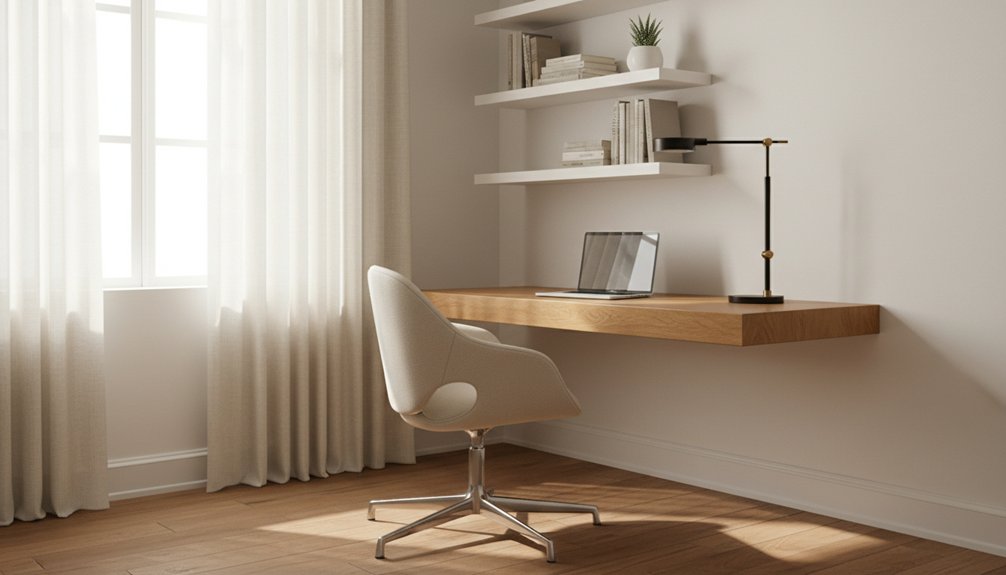
You can optimize a small home office by using space-saving furniture. Wall-mounted fold-down desks can save 15-20 square feet, allowing you to create a functional workspace without sacrificing room. Corner units utilize underused areas, maximizing every inch of space. Murphy desks collapse flat when not in use, providing flexibility in small rooms.
To keep supplies organized without taking up floor space, add floating shelves and vertical storage above your workspace. This approach helps maintain a clutter-free environment, which is essential for productivity. Choose convertible furniture, such as storage ottomans that double as seating or desk-to-dining tables for versatility.
When setting up your office in a bedroom, position your desk at least five feet away from your bed to create a clear boundary between work and rest areas. Use room dividers to separate your workspace from living spaces, enhancing focus and reducing distractions.
These strategies enable you to create a productive workspace in any corner of your home, ensuring that you can work efficiently even in limited space.
Compact Desks That Fit Small Office Spaces
Finding a compact desk that fits small office spaces requires careful consideration. Start by exploring designs like wall-mounted fold-down desks or corner units, which utilize otherwise wasted areas efficiently. These options maximize workspace without sacrificing room for movement.
Look for desks that include built-in storage compartments; this feature helps reduce the need for extra furniture and keeps your office organized.
When selecting a compact desk, prioritize comfort alongside size. Many modern designs incorporate ergonomic features, such as adjustable height mechanisms and keyboard trays, which help reduce strain during long work sessions.
Measure your available space accurately before purchasing a desk. Desks with dimensions between 36-48 inches wide generally provide enough surface area for productivity without overwhelming your workspace.
Be cautious of options that may not fit your specific needs. Avoid desks that lack adequate storage or ergonomic features, as these can lead to clutter and discomfort over time. Additionally, ensure that your desk maintains at least 36 inches of space between it and nearby furniture to facilitate comfortable movement.
Focus on models that combine functionality with a compact footprint to create an efficient work environment.
Wall Shelves, Floating Cabinets, and Vertical Storage
When floor space is limited, use wall-mounted shelves, floating cabinets, and vertical storage solutions to optimize your storage. Wall-mounted shelves provide easy access to frequently used items while keeping your desk and floor clear. Floating cabinets can create storage opportunities without taking up valuable floor area, and vertical organizers help utilize vertical space effectively.
Install corner shelving units to make the most of unused corners and create additional storage. Adding pegboards allows you to hang tools and supplies, keeping them organized and readily accessible. Mount cabinets that float on the wall to create the illusion of more space while providing essential storage.
Avoid bulky furniture that takes up too much room; instead, focus on lightweight, wall-mounted options that blend with your decor. Assess the weight capacity of each shelf or cabinet to ensure they can hold the intended items without sagging or falling. Choose materials that suit your environment, such as moisture-resistant shelves for humid areas. Additionally, consider using solid wood furniture for durability and a timeless aesthetic that enhances any workspace.
Maximize Your Wall Space
Maximize Your Wall Space
To maximize storage in a small home office, utilize wall space effectively. Install wall-mounted shelves and floating cabinets to create additional storage without taking up floor space. Move books, supplies, and decorative items onto these vertical surfaces to free up desk space. Position shelves directly above your desk to keep frequently used materials within easy reach.
Incorporate pegboards and wall-mounted organizers to add flexible storage options. These organizers allow customization as your storage needs evolve. Functional storage solutions can also enhance your workspace’s aesthetic. For example, arrange books by color, display attractive containers, or add plants to floating shelves.
By focusing on vertical storage, you can transform bare walls into organized, clutter-free areas that support productivity in your workspace.
When planning your wall storage, consider the weight and size of items you intend to store. Ensure that shelves and organizers are appropriately anchored to support their contents. Use materials that complement your office decor while maintaining functionality.
Always measure your wall space to maximize efficiency and avoid overcrowding.
Corner Shelving Solutions
Corner spaces in small home offices often remain unused, but these areas present valuable storage opportunities. Installing corner shelving allows you to transform these awkward spaces into functional storage solutions. Triangular shelves fit snugly into 90-degree angles, while L-shaped units effectively utilize wall space for maximum storage capacity.
When choosing materials for corner shelves, assess your office’s storage needs and design preferences. Wooden shelves offer durability and a warm aesthetic, while metal shelves provide a sleek, modern look and enhanced strength. Glass shelves can create an open and airy atmosphere, which is particularly beneficial in cramped areas.
Your corner shelving design should align with your workflow requirements. For items you access frequently, install floating shelves at eye level. For books and supplies, consider stacking multiple tiers vertically to optimize space. This strategic setup ensures you make the most of every available inch.
Remember that poorly designed corner shelves can lead to wasted space. Avoid overly deep shelves that make items difficult to reach. Instead, focus on shallow, accessible designs that cater to your specific storage needs.
Ultimately, effective corner shelving enhances organization and productivity in your home office.
Pegboards for Tool Organization
Pegboards provide effective organization for tools and supplies, especially in small spaces like home offices. These boards feature evenly spaced holes that accept various accessories, including hooks, baskets, and shelves. You can customize your layout by arranging these components to suit your specific storage needs.
Install pegboards directly above your desk to keep essential items accessible. Use them to organize office supplies, charging cables, and small tools. This setup allows for easy visibility and quick retrieval of items, reducing the need to search through drawers.
You can paint pegboards to match your office decor, enhancing both functionality and appearance. This practical solution maximizes vertical space while maintaining an organized workspace.
Be aware that pegboards may not support very heavy items. If you need to store heavier tools, consider using additional wall supports or a different storage method.
Folding and Wall-Mounted Furniture for Tight Spaces
Folding and wall-mounted furniture efficiently utilizes limited square footage. These designs increase functionality in small spaces while allowing you to reclaim floor area when not in use. Wall-mounted desks fold away against the wall, and Murphy beds include built-in workspaces, serving multiple purposes. Mobile workstations on wheels can be easily moved between rooms as needed.
| Furniture Type | Space Saved | Best For |
|---|---|---|
| Wall-mounted desk | 15-20 sq ft | Utilizing corners |
| Folding chair | 3-5 sq ft | Easy storage |
| Drop-leaf table | 10-12 sq ft | Adapting size |
| Rolling cart | 4-6 sq ft | Enhancing mobility |
| Murphy desk | 18-25 sq ft | Dual-function rooms |
These solutions maximize workspace without permanently sacrificing living areas, making them ideal for apartments and compact homes.
Wall-mounted desks provide significant space savings. They fit well in dedicated corners where traditional desks might not work. By folding up against the wall, these desks free up 15 to 20 square feet when not in use.
Folding chairs offer a quick storage solution. These chairs save 3 to 5 square feet and can be easily tucked away when guests are not present.
Drop-leaf tables allow for flexible sizing in dining or workspace areas. When extended, these tables can save 10 to 12 square feet, making them suitable for various activities.
Rolling carts enhance mobility within tight spaces. These carts can save 4 to 6 square feet and can be moved easily between rooms, providing versatile storage and workspace options.
Murphy desks are ideal for multi-use rooms. They can save 18 to 25 square feet by integrating a desk into a wall bed system. This design allows for an efficient workspace without sacrificing the comfort of a bedroom.
While these solutions are highly effective, they do have limitations. For instance, wall-mounted desks require wall space and proper installation. Murphy beds need sufficient ceiling height for effective operation. Understanding these constraints helps in choosing the right furniture for your specific needs. Additionally, furniture selections that incorporate functional design principles can greatly enhance the usability of compact spaces.
Office Furniture That Converts and Multi-Tasks
Convertible furniture optimizes your workspace by offering multiple functions throughout the day. For example, convertible desks fold into cabinets when not in use, effectively hiding office clutter. Storage ottomans serve as both seating and file holders. Desk-to-dining tables allow you to work during business hours and host dinner afterward. These space-saving solutions maximize every square foot of your home office.
Murphy desks fold away into walls, freeing up space when not in use. Bookcases with hidden workstations provide an efficient use of vertical space. Lift-top coffee tables serve as laptop surfaces without requiring a dedicated office area. Rolling carts store office supplies and function as mobile work surfaces. Nesting tables separate for projects and stack away when finished. Multi-tasking furniture helps you maintain distinct work and living areas in limited square footage.
When choosing convertible furniture, consider your specific needs. Identify the space you have and how you want to use it. For example, if your workspace doubles as a dining area, a desk-to-dining table is ideal.
If you work in a small apartment, a murphy desk can provide a functional workstation without sacrificing floor space. Remember, effective convertible furniture should meet your requirements while blending seamlessly into your home’s design.
Layout Strategies That Maximize Small Office Space
Efficient layout strategies can significantly enhance the functionality of small home offices. Position the desk in a corner to optimize floor space and establish a clear work zone. Use vertical storage solutions, such as wall-mounted shelves and cabinets, to keep items organized without taking up valuable floor area. Select furniture that serves multiple purposes, like a desk with built-in storage or a foldable table, to maximize utility.
Incorporate task lighting to ensure adequate illumination while working, and choose ergonomic chairs to support comfort during long hours. Keep the workspace clutter-free; regularly assess and remove unnecessary items to maintain focus. Avoid bulky furniture that overwhelms small spaces; instead, opt for streamlined designs that complement the office’s overall layout.
Additionally, consider the flow of movement within the office. Ensure there’s enough space to move around comfortably, especially if the office is used for video calls or meetings. Assess your specific needs, such as whether you require additional seating for visitors or a dedicated area for paperwork, and adjust your layout accordingly.
Limitations may arise when working with extremely compact spaces. In these cases, prioritize essential items and consider using mobile furniture that can be easily rearranged or stored away when not in use.
Corner Desk Placement Benefits
Placing a desk in the corner of a home office optimizes space and enhances functionality. Utilizing corner areas, which often remain vacant, allows you to free up valuable floor space for additional furniture or movement.
A corner desk design effectively uses two walls for support, creating an L-shaped workspace that provides more usable surface area compared to traditional straight desks.
Key advantages of corner desk placement include:
- A corner desk increases desktop space, accommodating multiple monitors, documents, and office supplies efficiently.
- The L-shape design helps distinguish work zones from living areas, promoting focus and organization.
- Two walls enable additional storage solutions, such as shelves or cabinets, keeping your workspace tidy.
- Facing outward from the corner improves your awareness of the room, reducing feelings of confinement.
- Having walls on either side simplifies cable management, allowing for cleaner routing of wires and reducing clutter.
This placement converts often neglected corners into effective workstations that support productivity and organization.
Vertical Storage Solutions
Vertical storage solutions effectively convert wall space into organized storage areas, allowing you to keep essential items easily accessible while preserving floor space.
Install shelving units above your desk to create specific spots for books, supplies, and decorative items that enhance productivity. Floating shelves are particularly useful in tight spaces because their design eliminates the need for bulky brackets or floor supports, giving you a clean look without sacrificing functionality.
A vertical file organizer mounted on the wall helps you keep important documents sorted and within reach, freeing up valuable desk surface area for your daily tasks.
To make the most of your wall’s height, consider stacking storage cubes vertically, which provides additional storage without consuming horizontal space. Wall-mounted pegboards allow for customizable storage solutions that adapt as your needs change, making them versatile for various items like tools, craft supplies, or office materials.
These vertical storage solutions utilize often-overlooked wall space, ensuring you maintain an organized workspace even when your square footage is limited.
Remember that not all vertical storage options are suitable for every environment; for instance, heavier items may require sturdier shelving systems to avoid collapse.
Focus on your specific storage needs and choose solutions that align with your workspace requirements.
Multi-Functional Furniture Arrangements
Maximizing limited office space requires selecting furniture that offers multiple functions. These multi-functional furniture pieces allow you to work efficiently while minimizing clutter.
You can adjust your office setup throughout the day to accommodate various tasks without sacrificing space.
Consider these practical multi-functional furniture options:
- Murphy desks fold flat against the wall when you finish working, freeing up floor space.
- Storage ottomans provide both seating and hidden compartments for office supplies, keeping your workspace organized.
- Convertible standing desks adjust easily between sitting and standing positions, promoting better posture and comfort during long work hours.
- Bookshelf room dividers separate different areas of your office while providing valuable storage for books and supplies.
- Nesting tables fit together neatly, allowing you to expand your surface area when needed, then collapse to save space.
Each of these pieces serves multiple functions, maximizing utility without requiring additional square footage.
These solutions effectively transform your office into a more adaptable and efficient workspace.
Setting Up a Small Home Office in Your Bedroom
When your bedroom serves as your home office, you must establish clear boundaries between relaxation and work. Position your desk at least five feet away from your bed to ensure a physical separation between your sleeping area and workspace.
Select a compact corner desk or a wall-mounted desk to optimize your floor space while maintaining an effective work area. Choose an ergonomic chair that provides support for your back and promotes good posture during working hours, while also matching the decor of your bedroom.
Maximize limited space with strategic furniture choices—compact desks and supportive seating that blend functionality with your bedroom’s aesthetic.
Install room dividers or hang curtains to create a visual barrier between your office space and your sleeping area. Use task lighting, such as a desk lamp, to illuminate your workspace without disrupting the overall ambient lighting in your bedroom, which is essential for relaxation.
Implement cord management solutions, like cable clips or sleeves, to keep electrical cords organized and prevent clutter around your desk. Store your work materials in closed containers or drawers to help you mentally disconnect from work when your day ends.
Turning Living Room Corners Into Work Areas
Living room corners often serve as wasted space, but with some thoughtful planning, you can convert them into efficient workspaces that blend seamlessly with your home. Corner desks, especially triangular or L-shaped designs, utilize this area effectively without disrupting your living room’s primary function. By strategically placing furniture, you can create a dedicated workspace that remains comfortable and visually appealing.
When transforming a corner into a workspace, keep these key elements in mind:
- Install a corner desk to maximize the available area. These desks fit snugly in corners and provide ample surface space for a computer and office supplies.
- Add floating shelves above the desk to store books, files, and decorative items. This solution keeps the floor space clear while providing easy access to necessary materials.
- Incorporate task lighting to illuminate your workspace. Proper lighting reduces eye strain, making it easier to focus during long work hours.
- Implement cable management solutions to keep cords organized and out of sight. Using cable clips or a cable box helps maintain a tidy appearance and prevents clutter.
- Use decorative screens to separate your workspace from the living area when needed. Screens can create a sense of privacy and help define the work zone.
This method allows you to maintain the living room’s social atmosphere while establishing a functional work area that meets your needs.
Murphy Desks and Hideaway Furniture Solutions
Murphy desks provide effective solutions for small home offices by offering furniture that collapses when not in use. These desks fold flat against the wall, allowing homeowners to convert a workspace into open floor space quickly.
Each Murphy desk features built-in shelving and storage compartments that remain accessible even when the desk is closed. Options range from basic fold-down tables to complex cabinet systems with various organizational elements.
Hideaway desks deliver more than just space-saving benefits. They create physical separation between work and personal life by keeping the office out of sight. You can install these desks in bedrooms, hallways, or closets without needing to dedicate entire rooms to an office setup.
Modern hideaway desks accommodate laptops, monitors, and essential supplies, supporting weight limits of up to 50 pounds. These desks are particularly advantageous for renters, as most models require minimal wall damage during installation.
Considerations for choosing a Murphy desk include the available wall space and your specific work needs. Not all models can support heavier equipment, so it’s essential to check weight limits before purchasing.
Additionally, ensure the desk fits your style and the overall design of your home.