
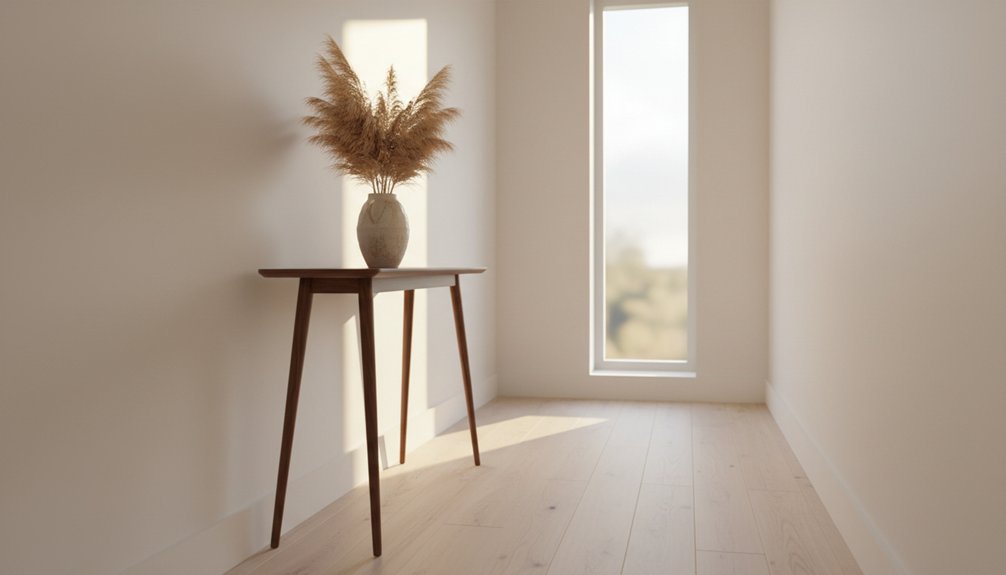
To effectively choose a console table for a small hallway, select a depth between 20cm and 30cm. Measure your hallway width first. After measuring, subtract the table depth from your hallway width to ensure at least 91cm (36 inches) of clearance for comfortable walking. A 20cm deep console table fits best in very tight spaces, while a 30cm deep table provides additional surface area for items like keys and mail.
Consider wall-mounted console tables to completely free up floor space. When selecting materials, opt for glass or metal to maintain an open feel, as these options are less bulky compared to wood.
For practical application, ensure that console tables have specific measurements that align with your hallway dimensions. Assess storage solutions that fit within the depth constraints, and explore styling techniques that enhance the narrow hallway’s functionality and aesthetics without overcrowding the space. Avoid options that are too wide or deep, as they will restrict movement and create an uninviting atmosphere.
How Narrow Does a Console Table Need to Be for a Tight Hallway?
When selecting a console table for a tight hallway, focus on both the table’s depth and the available walkway space. Standard console tables typically measure between 12 to 15 inches deep, but if your hallway is particularly narrow, consider ultra-slim options that range from 6 to 10 inches deep.
To ensure comfortable movement, maintain at least 36 inches of clear walking space in your hallway. For example, if your hallway measures 48 inches in width, a console table with a depth of 10 to 12 inches is optimal.
For hallways 48 inches wide, pair a 10-12 inch deep console table with 36 inches of clear walking space.
Measure your hallway carefully before making a purchase. Stand in the space to visualize daily movement around the furniture. Choose a console table that provides enough surface area for essentials like keys and mail, while avoiding obstruction in your pathway.
Wall-mounted or floating console tables offer an excellent solution for saving floor space while still delivering functionality.
Measure Your Hallway Before Shopping for a Narrow Console
Before you shop for a narrow console table, measure your hallway accurately to ensure the furniture fits well.
Measure the width of your hallway and consider the standard widths, which typically range from 36 to 48 inches.
Determine the maximum depth for your console table by allowing at least 24 inches of clearance for comfortable passage.
Use a tape measure to record the exact dimensions, including any wall features that could affect placement.
Knowing these measurements will help you select a console that complements your space without being an obstruction. Additionally, maintaining at least 30 inches of clearance for walkways is crucial to facilitate movement.
Standard Hallway Width Guidelines
Most residential hallways measure between 36 and 48 inches wide. Older homes may feature wider hallways, offering homeowners more options for furniture placement.
In contrast, modern apartments and condos typically have narrower corridors, which require slimmer furniture profiles. Building codes mandate a minimum hallway width of 36 inches to ensure safe passage.
After placing furniture, you should leave at least 24 to 30 inches of clearance in your hallway to maintain ideal traffic flow.
When selecting furniture, specifically console tables, aim for pieces that are 10 to 12 inches deep in narrower hallways. This depth allows for functional use without obstructing movement.
Always consider the width of your hallway when deciding on furniture styles and dimensions; this attention to detail helps create a harmonious living space that accommodates daily use.
Essential Clearance Space Requirements
Measuring your hallway before buying a console table is crucial to avoid costly mistakes. First, measure your hallway’s width from one wall to the other. Then, subtract the console table’s depth from this measurement. This calculation gives you the remaining clearance space, which is essential for comfortable passage.
Industry standards dictate that you should maintain at least 36 inches of clearance for single-person traffic. If your household often has two-way traffic, aim for a minimum of 48 inches.
Next, measure any doorways and corners along the delivery route. A console table that fits your hallway might still be difficult to transport if movers can’t navigate through tight spaces.
Keep a record of these measurements and have them accessible while you shop online or visit stores. This ensures you select a console table that fits both your hallway and your delivery path.
Tools for Accurate Measurements
A traditional metal tape measure is the most reliable tool for measuring hallways. Use this tool to take accurate measurements of your space before purchasing a console table.
Essential Measurement Tools:
- Retractable tape measure: Use a tape measure that’s at least 25 feet long for accurate width, length, and height measurements.
- Pencil and notepad: Record all dimensions immediately after measuring to avoid forgetting any details.
- Level tool: Check for floor slopes or wall lean to understand how these factors may affect furniture placement.
- Smartphone camera: Take photographs of the space with measurements visible to reference later.
While digital measuring devices can offer convenience, they may struggle in narrow spaces or on reflective surfaces. If you use a digital measuring device, always verify your readings with a traditional tape measure.
Measure three times to ensure accuracy. Record the hallway’s width at multiple points, especially in older homes where dimensions can be uneven, impacting how furniture fits.
Console Table Depths: 20cm Ultra-Slim vs. 30cm Standard Narrow
When choosing a narrow console table, understanding depth measurements is crucial for functionality and fit. Ultra-slim 20cm console tables are ideal for tight hallways where space is limited. These tables efficiently hold keys, mail, and small decorative items without obstructing walkways.
However, the 20cm depth restricts the placement of larger lamps or substantial decor pieces.
In contrast, standard narrow 30cm console tables provide greater versatility. These tables accommodate a wider range of styles, from modern minimalist to traditional designs. A 30cm depth offers sufficient surface area for both functional items and decorative elements.
When selecting a console table, consider your hallway width. If your hallway has less than 90cm of clearance, a 20cm depth is the better choice. On the other hand, if your space allows for it, a 30cm table fits comfortably without hindering movement, providing you with more options for decor and functionality.
Remember that both depths offer a variety of materials, including wood, metal, and glass, to suit your style preferences. Additionally, choosing solid wood furniture can enhance the durability and aesthetic appeal of your console table.
Wall-Mounted Console Tables That Free Up Floor Space
Wall-mounted console tables solve space issues in narrow hallways. These tables attach directly to the wall, removing bulky legs that take up valuable floor space. This design allows for easy cleaning, as you can vacuum or mop underneath without needing to move any furniture.
When selecting a wall-mounted console table, consider these key advantages:
- Adjustable Height – You can install the table at a height that fits your specific needs.
- Easy Cleaning – The open space beneath the table allows for simple maintenance tasks.
- Space Illusion – Floating designs help narrow hallways feel larger and less cluttered.
- Strong Support – Modern mounting brackets provide substantial weight support when installed correctly into wall studs.
Wall-mounted console tables are particularly effective in hallways that are less than three feet wide. Additionally, their minimalist design complements various decor styles, making them versatile for modern homes.
Narrow Console Tables With Drawers, Shelves, and Hidden Storage
Narrow console tables with storage features serve as organized command centers in hallways. Drawers provide hidden storage for keys, mail, and small essentials, ensuring quick access without clutter on the surface. Multi-level shelves utilize vertical space, allowing for designated spots for baskets, decorative items, and everyday belongings. This design prevents the table from feeling bulky while maximizing functionality.
When selecting a narrow console table, consider the specific storage needs. Look for tables with at least two drawers for efficient organization. Ensure shelves are sturdy enough to hold decorative items and functional storage baskets. Avoid tables with shallow drawers that can’t accommodate standard-sized mail or larger items.
In practice, a well-designed narrow console table should measure between 30 to 36 inches in height to fit comfortably in most hallways. The width typically ranges from 12 to 18 inches, making it ideal for tight spaces. For effective organization, each shelf should be spaced at least 12 inches apart to accommodate varying item sizes.
Limitations exist with narrow console tables. Tables without adequate storage may lead to clutter on the surface, defeating the purpose of organization. Additionally, ensure that the materials used are durable to withstand daily use, especially if the table is placed in a high-traffic area.
Drawer Organization and Accessibility
Maximize the functionality of narrow console tables by focusing on their internal organization systems. Understanding drawer types helps you select tables that meet your specific storage needs.
When choosing your console table, prioritize these accessibility features:
- Soft-close mechanisms prevent drawer slamming, protecting your stored items from damage.
- Full-extension glides enable complete access to drawers, ensuring you can easily reach items stored at the back.
- Divided compartments organize small essentials like keys, sunglasses, and mail, making them easy to find.
- Smooth-operating hardware allows for effortless opening, even when your hands are occupied.
Investing in quality drawer construction enhances daily use. Look for dovetail joints and solid wood construction instead of particle board.
These sturdy features ensure your narrow console table functions well for years while keeping your entryway tidy.
Multi-Level Shelf Configurations
Three levels of storage enhance a narrow console table, transforming it from a simple surface into an effective organization system. Multi-level designs utilize vertical space efficiently while keeping a slim profile. The top surface serves as a landing spot for keys, mail, and decorative items. The middle shelf accommodates books, baskets, or photos, while the bottom shelf is designed for shoes, bags, or storage bins.
| Shelf Level | Best Storage Items |
|---|---|
| Top Surface | Keys, mail, décor |
| Middle Shelf | Books, baskets, photos |
| Bottom Shelf | Shoes, bags, bins |
You can adjust or remove shelves to create taller storage areas based on your specific needs. This adaptability ensures your console table evolves with your organizational requirements, making it a practical long-term investment. This flexibility allows for customization, enabling you to maximize the storage potential of each level.
When choosing items for storage, consider the dimensions and weight of each item. Ensure the middle shelf can support heavier books or multiple baskets without sagging. For the bottom shelf, select bins that fit comfortably without overcrowding the space. This attention to detail guarantees that your console table remains functional and organized.
Limitations may arise if you overload the shelves beyond their intended capacity. Avoid placing excessively heavy items on the middle shelf, as this can affect the overall stability of the table. By following these guidelines, you can create a well-organized space that meets your specific storage needs.
Glass, Metal, and Wood: Best Materials for Narrow Hallways
When selecting a console table for a narrow hallway, the choice of material is crucial. The material influences both the table’s visual weight and its durability, especially in confined spaces.
Material Comparison:
- Glass offers a transparent design that allows light to flow through, helping to maintain an open feel in narrow hallways. Choose tempered glass for its strength and resistance to shattering from everyday bumps.
- Metal presents a sleek look with minimal bulk. Opt for metal tables that feature clean lines for a modern or industrial aesthetic. Metal also provides robust structural integrity, making it suitable for high-traffic areas.
- Wood provides versatility and warmth, fitting styles from traditional to contemporary. Select solid wood for durability and a variety of finishes to match your existing decor.
- Maintenance requirements differ among materials. Glass needs regular cleaning to eliminate fingerprints and smudges. Metal is generally stain-resistant but can scratch; choose finishes that minimize visible wear. Wood requires occasional polishing to preserve its sheen and protect against scratches.
Best Positions for Your Narrow Console Table in Small Spaces
Best Positions for Your Narrow Console Table in Small Spaces
To optimize your narrow console table’s functionality in a small hallway, position it directly inside your entryway. This creates a convenient drop zone for keys and mail.
Center the table along your longest wall to ensure clear walking paths on both sides, allowing for easy movement. When placing the table, consider positioning it beneath a window to take advantage of natural light for displaying decorative items.
For corners that are difficult to navigate, angle your console table at 45 degrees. This arrangement softens the sharp edges and adds visual interest to the space.
Avoid placing the table in front of doorways or high-traffic areas, as this can impede movement. Aim for at least 36 inches of walking space around the table to ensure comfort and accessibility.
If you want to enhance the visual depth of your small hallway, position your narrow console table opposite a mirror. This setup will reflect light and create the illusion of a larger space, making your hallway feel more open and inviting.
Styling Your Narrow Hallway Console Without Creating Clutter
Everything you place on your narrow console table should either serve a function or bring you joy. Minimalist decor works well in tight hallways because it prevents the space from feeling cramped.
Choose pieces that work hard and look beautiful—your narrow console deserves both purpose and personality in equal measure.
Focus on choosing functional accessories that enhance your daily routine while keeping the area visually appealing.
Four Essential Styling Guidelines
- Limit to Three Main Items: Position a lamp, a small tray, and a decorative object on your console table. This combination creates visual balance without overcrowding the surface.
- Use Vertical Storage: Install wall-mounted hooks above the console table. These hooks maximize space efficiency and provide a designated spot for items like bags or coats.
- Select Slim Accessories: Opt for narrow vases and compact organizers that align with the proportions of your console table. Slim accessories prevent visual clutter while adding style.
- Maintain Clear Surfaces: Designate specific areas for keys and mail on your console table. Remove everything else to keep the surface clear and organized.
By following these guidelines, you’ll maintain a functional hallway that avoids clutter.
You’ll create an organized entryway that welcomes you home without overwhelming the space.
Floating Shelves vs. Narrow Console Tables: Which Saves More Space?
When deciding between floating shelves and narrow console tables in a small hallway, consider your specific needs and space limitations. Floating shelves mount directly to the wall, allowing you to free up floor space entirely. In contrast, narrow console tables require at least 6 to 12 inches of floor space, but they provide both surface area and storage underneath.
Here’s a practical comparison of their features:
| Feature | Floating Shelves | Console Tables |
|---|---|---|
| Floor Space | Zero | 6-12 inches minimum |
| Storage Capacity | Limited to the depth of the shelf | Multiple levels of storage available |
| Visual Weight | Minimal, creating an airy feel | More substantial, adding presence to the space |
| Functionality | Primarily for display | Offers display and concealed storage |
If you want a place to drop keys while keeping the floor open, floating shelves are the right choice. However, if you need extra storage for items you want to keep out of sight, a narrow console table may be more beneficial. Each option serves distinct functions, so evaluate how you use your hallway to make the best choice.