

How to Vet a Furniture Supplier Before Your First EU Wholesale Order
We vet a furniture supplier with seven checks before the first purchase order: VAT and company identity, factory address, certificates, buyer references, a production-standard sample, delivery records, and payment terms. The full process takes 10 to 15 working days and costs one paid sample plus freight. We reject a supplier when any identity check fails, and we do not negotiate price until all seven checks are complete.
Verify the Supplier’s Identity
We verify identity by matching the VAT number, legal name, and registered address across three sources. First, we enter the VAT number in VIES. A “valid” result confirms an active VAT registration, but Germany and Spain return no name or address, so we request the VAT certificate as well. Second, we pull an extract from the national company register (Handelsregister, KRS, Registro Mercantil, or Registro Imprese) and compare legal name, address, directors, and incorporation date. Third, we compare both results with the name on the supplier’s quotation and bank details.
VIES does not cover suppliers outside the EU. For those suppliers, we ask for the business licence, check the number in the local register, and validate the EORI number in the EU EORI database.
Confirm the Factory Address
We confirm the factory address with a live video walk-through, not with photos. We ask the supplier to show the cutting line, the finishing area, and the finished-goods warehouse, then to film the street sign or gate number. We compare that address with the register extract. A trading company and a factory are separate legal entities, so we ask for the factory’s own business licence when the quoting company does not own the site.
Confirm Certificates With the Issuing Bodies
We confirm certificates by checking each one with the body that issued it. For FSC, we search the certificate code in the FSC public database and check the status, expiry date, product groups, and legal name. We then email the certification body to confirm the scope covers the exact products and the factory site we are ordering from. An FSC certificate held by a parent company does not cover a separate factory.
CE marking needs a different approach. Most plain furniture carries no CE mark, because no CE directive covers it; the General Product Safety Regulation (EU) 2023/988 applies instead. CE marking is mandatory only for furniture with electrical parts, such as height-adjustable desks or built-in LED lighting, under the Low Voltage Directive and the EMC Directive. We request the declaration of conformity for those products. A CE mark on a plain wooden chair with no declaration of conformity is a warning sign, not proof of quality.
We also request test reports from an accredited laboratory, dated within the last three years, against the relevant standards: EN 1728 for seating strength, EN 1730 for tables, EN 12520 for domestic seating, and EN 14749 for storage units. For wood products, we ask for the species, country of harvest, and plot geolocation data that EUDR due diligence requires.
Call Three to Five Recent EU Buyers
We call three to five EU buyers who ordered within the last 12 months. We ask each buyer for the order size, the on-time delivery record, the defect rate, the time the supplier needed to settle claims, and whether the buyer reordered. We reject a supplier who cannot name three reachable buyers. Suppliers choose their own references, so we also ask for one buyer taken from shipping documents, which we cannot pre-screen.
Test a Production-Standard Sample
We test a sample pulled from the production line, not from the showroom, and we pay for the sample. We measure every dimension against the spec sheet with a tolerance of ±2 mm. We check wood moisture content with a pin meter and accept 8% to 12%. We test finish adhesion, hardware torque, and packaging by dropping the carton from 80 cm. We photograph every result and file the measurement sheet.
A hand-built workshop sample proves craftsmanship, not production consistency. For that reason, we also book a pre-shipment inspection at AQL level II for the first order and compare the inspected units with the approved sample.
Confirm Delivery Records and Payment Terms
We request bills of lading or CMR notes for the supplier’s last five shipments and compare actual dates with promised dates. We accept a supplier when at least four of five shipments arrived within seven days of the promised date.
We split payment into a 30% deposit and a 70% balance, paid after the pre-shipment inspection passes or against a copy of the bill of lading. We pay only to a bank account held in the verified legal entity’s name and in the same country as the factory. For a first order above €50,000, we consider a letter of credit.
Red Flags That End the Vetting
We stop the vetting when we find any of the following:
- The bank account name differs from the registered company name.
- The VAT number is invalid, or the name returned does not match the quotation.
- The FSC code does not appear in the database.
- The supplier refuses a live video walk-through.
- The quoted price sits more than 20% below three comparable quotes.
- The supplier demands a deposit above 50%.
- The production sample differs from the approved sample in material, finish, or construction.
Documents to File
We file the dated VIES screenshot, the register extract, the FSC database printout, the lab test reports, the reference call notes, the sample measurement sheet, the inspection report, and the signed purchase agreement in one folder per supplier. We keep this folder for at least five years, the retention period EUDR requires for due diligence records.
Verify an EU Furniture Supplier’s VAT and Registration
Procurement verifies an EU furniture supplier in four steps before the first purchase order or deposit: collect four identifiers, validate the VAT number in VIES, confirm the company in its national business register, and file the proof. The full check takes 20 to 30 minutes per supplier. This procedure covers suppliers in the 27 EU member states and Northern Ireland (prefix XI). Suppliers with a UK prefix (GB) aren’t in VIES and need a separate process.
Procurement verifies every EU furniture supplier in four steps before the first purchase order or deposit, and the full check takes 20 to 30 minutes.
Collect the supplier’s four identifiers
Procurement requests four identifiers from the supplier in writing: full legal name with legal form (GmbH, SARL, S.r.l., Sp. z o.o.), registered address, company registration number, and VAT number. Procurement compares each identifier with the quote, the proforma invoice, and the contract header.
A VAT number starts with a two-letter country prefix, for example DE plus 9 digits for Germany, FR plus 2 characters and 9 digits for France, IT plus 11 digits for Italy, and PL plus 10 digits for Poland.
Procurement rejects a trading name in place of the legal name, because the register and VIES list only the legal name.
Validate the VAT number in VIES
Procurement enters the supplier’s VAT number in the European Commission’s VIES tool and enters our own VAT number as the requester. VIES then issues a consultation number, which is the proof of the check. VIES returns “valid” or “invalid” and, for most member states, the registered name and address.
The returned name and address must match the supplier’s quotes and invoices. Procurement accepts abbreviation differences such as “Str.” for “Straße” and rejects any different company name or different city.
VIES has three limits:
- Several member states, including Germany and Spain, often return “—” instead of a name and address. In that case, procurement requests the supplier’s VAT registration certificate and checks the details against the register.
- An “invalid” or “service unavailable” result can come from a temporary outage in the member state’s database. Procurement retries after 24 hours before treating the number as invalid.
- A “valid” result confirms the number is active. VIES doesn’t confirm the directors, the company’s solvency, or that the person we’re talking to works for the number’s holder.
Cross-check the company in the national business register
Procurement looks up the supplier in the national business register of its country of incorporation. Examples are the Handelsregister in Germany, Infogreffe in France, the Registro Imprese in Italy, the Registro Mercantil in Spain, and the KvK in the Netherlands.
For other countries, procurement uses the European e-Justice portal’s “Find a company” search, which links to each national register.
Procurement confirms five facts: the status is active (not in liquidation, insolvency, or struck off), the incorporation date, the names of the directors or legal representatives, the registered address, and the registration number. Some registers charge a small fee for an official extract, and procurement pays that fee.
A company incorporated in the last six months that asks for a large deposit carries higher risk, so procurement limits the deposit or requests a bank guarantee.
Treat mismatches and refusals as stop signals
Procurement stops the order when any of these conditions appears:
- VIES returns “invalid” twice, 24 hours apart.
- The VIES name or address differs from the invoice.
- The register shows liquidation, insolvency, or deregistration.
- The supplier refuses to send a registration extract or VAT certificate.
- The bank account sits in a different country than the registered seat, or the account holder name differs from the legal name.
The supplier’s director must explain each discrepancy in writing, and procurement repeats the VIES and register checks with the corrected documents. Procurement places no order and pays no deposit until the discrepancy is resolved in writing.
Save the VIES consultation record
Procurement saves the VIES result as a PDF showing the consultation number, date, and time. Procurement also saves the register extract with its retrieval date. Both files go into the supplier’s file, linked to the purchase order number.
Auditors ask for proof that the supplier’s VAT number was valid on the invoice date, and the consultation number provides that proof. Procurement keeps the files for the statutory retention period for invoices in our country, which ranges from six to ten years. Procurement repeats the VIES check before every deposit and at least once every 12 months for active suppliers.
Once the supplier passes these checks, procurement also confirms that the quoted sofa and table dimensions match the delivery dimensions of the doorways and hallways at the destination to avoid installation issues.
Check Furniture Supplier CE and FSC Certificates
We check two certificates for every furniture supplier: CE documentation and the FSC certificate. CE covers product safety. FSC covers wood sourcing. Each check takes about 30 minutes per supplier, and we repeat both before every reorder. A supplier that fails either check doesn’t receive a purchase order.
Check CE Documentation
We check CE documentation by first confirming that an EU directive or regulation applies to the product. A solid wood chair has no CE requirement, so a CE mark on one makes us ask the supplier which directive the supplier is claiming. Electric sit-stand desks and powered recliners fall under the Low Voltage Directive and the EMC Directive, so these products need CE documentation.
For every product in scope, we request three documents:
- Declaration of Conformity: The declaration names the directive, lists the applied standards, identifies the product by model number, and carries a signature.
- Test reports: The reports come from a laboratory accredited to ISO/IEC 17025, and the model number on each report matches the product we’re ordering.
- Manufacturer details: The manufacturer’s name and address appear on the declaration. If the manufacturer is outside the EU, the declaration also names an EU authorized representative or importer.
If a supplier can’t produce all three documents within 5 working days, we stop the order.
Verify FSC Certificates
We verify FSC certificates by entering the supplier’s license code in the public FSC database at info.fsc.org. We check three fields:
- Status: The certificate shows as valid, not suspended or terminated.
- Scope: The product group includes wooden furniture or the specific component we’re buying.
- Name: The certificate holder matches the legal entity on our contract.
We then compare the claim on the supplier’s invoice to the certificate. The invoice must show the supplier’s certificate code and a claim of FSC 100%, FSC Mix, or FSC Recycled that the certificate covers.
A valid certificate doesn’t certify our shipment if the invoice carries no claim. A trader’s certificate also doesn’t cover a subcontracted factory unless the certificate lists that factory.
Certified timber still needs sound construction, so we also look for solid wood furniture built without particle board, plywood, or engineered wood.
Confirm Authenticity With the Issuing Body
We confirm authenticity by contacting the body that issued each document, because a PDF or a logo can be copied in minutes. We don’t accept either as proof.
- FSC: We email the certification body named in the database, such as SGS or Bureau Veritas, quote the license code, and ask for written confirmation of status and scope.
- CE: No central CE database exists, so we contact the testing laboratory, quote the report number, and ask the laboratory to confirm that the laboratory issued the report for that model.
Track Expiry Dates
We track expiry dates by recording every date in the supplier file and setting a reminder 60 days before each one.
FSC certificates run for five years with annual audits, so a supplier’s status can change before the printed expiry date. For that reason, we recheck the FSC database before every reorder.
A Declaration of Conformity has no expiry date, so we request a new one whenever the supplier changes the design, a component, or the applied standard.
Call Past Customers Before You Order
We call three to five EU buyers who ordered from the supplier within the last twelve months before we place any order. Each call checks what certificates cannot: whether the goods matched the approved sample, whether delivery met the agreed date, and whether the shipment included complete CE documents and FSC chain-of-custody records. Each call takes about 15 minutes.
We place no order until the supplier resolves every complaint about delays or missing documents.
Why Certificates Do Not Replace Reference Calls
Certificates confirm that the supplier’s paperwork was valid on the audit date. Certificates don’t record how the supplier performs after we pay the deposit.
Past customers can report on delivery, product quality, and document handling after payment, so we call them.
Request References From the Supplier
We ask the supplier for three to five EU buyers who ordered within the last twelve months. Orders older than twelve months don’t count, because the supplier’s staff, subcontractors, and material sources may have changed since then.
If the supplier offers only handpicked contacts or hesitates to name buyers, we treat the response as a warning and ask for additional references.
Verify Website Testimonials
We match each testimonial on the supplier’s website to a registered company, then contact that company directly.
A testimonial that we can’t trace to a real company doesn’t count as a reference.
Ask Specific Questions
We ask every buyer the same four questions:
- Did the goods match the approved sample?
- Did delivery meet the agreed date?
- Were the CE documents and FSC chain-of-custody records complete at shipment?
- How did the supplier handle damaged or non-compliant items?
General questions such as “Are you satisfied with the supplier?” produce general answers, so we don’t use them.
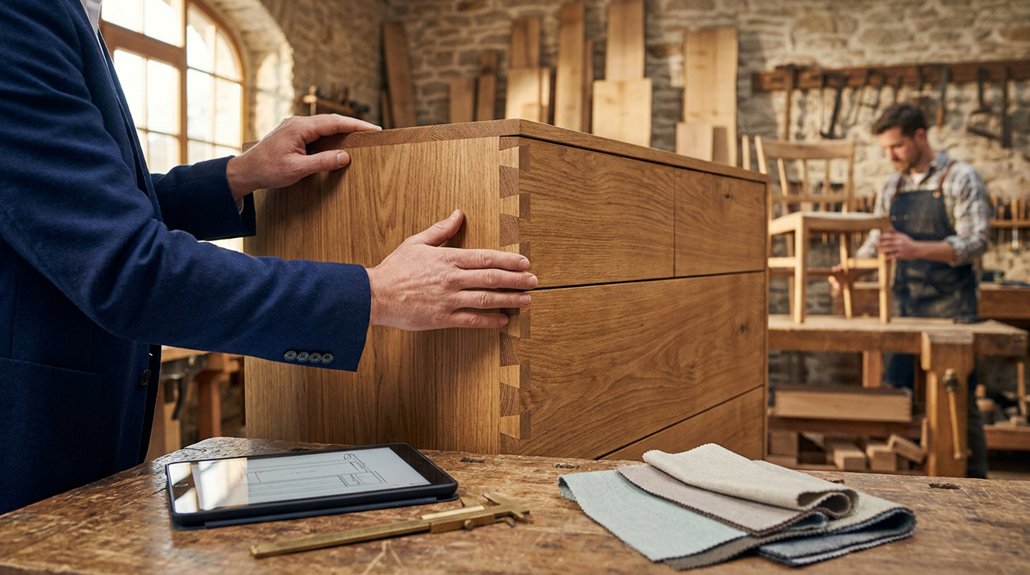
Buyers of traditional pieces can also tell you whether the dovetail joints and hand-carved details matched the approved sample.
Record Answers and Decide
We record every answer in writing. Complaints about delays or missing documents from two or more buyers count as a pattern.
We ask the supplier to explain the cause and show the correction, and we place the order only after the supplier resolves the problem.
A single complaint that the supplier fixed and documented doesn’t block the order.
Order Samples to Test Furniture Supplier Quality
Order one production-standard sample from every supplier who passes reference calls, and test durability, compliance documents, and material consistency against the written specification sheet before you place a bulk order. Budget 10 to 25 days for sample production and expect to pay 1 to 3 times the unit price plus freight.
Order one production-standard sample from every supplier who passes reference calls, then test durability, compliance documents, and material consistency before placing a bulk order.
Order a second sample from a different production batch, because the difference between the two samples predicts the variation in a full 40 ft container.
Request a Production-Standard Sample
Ask the supplier to build the sample on the production line, with the same materials, hardware, and finish that the bulk order will use. A showroom piece proves that the factory can build one excellent unit by hand. A production-standard sample proves what the line delivers on an ordinary day.
Send the supplier the signed specification sheet with dimensions, board grade, foam density, fabric weight, hardware brand, and finish type, and ask for written confirmation that the sample matches every line. If the supplier refuses to build from the line, or quotes more than 4 weeks, treat that as a warning about the bulk lead time.
Test Sample Durability
Test durability by loading, cycling, and inspecting the sample in your own workshop or warehouse before you pay for a lab.
Load a chair rated for 110 kg with 165 kg (1.5 times the rating) for 10 minutes, then check the legs, rails, and glue joints for movement, cracks, or a permanent lean. Fill a drawer with 10 kg and open and close it 200 times, then check the runners for sticking, the front for loosening, and the box joints for gaps. Swing each hinged door 200 times and tighten no screws during the test.
Rub the finish with a cloth soaked in isopropyl alcohol, then scratch an unseen edge with a coin to check coating adhesion.
These in-house checks screen out weak samples, but they don’t replace an accredited lab test. Send the sample that passes to a lab for EN 12520 (domestic seating), EN 16139 (non-domestic seating), or EN 14749 (storage units) before you commit to a large order.
Confirm Compliance Documents
Compare every certificate and label with the physical sample, and reject any document that doesn’t name the same product, material, and factory.
Check that the flame-retardant label matches your destination market, such as the UK Furniture and Furnishings (Fire) (Safety) Regulations 1988 or California TB 117-2013. Check that the formaldehyde report states the class for the board in your sample (E1 at or below 0.124 mg/m³ under EN 717-1, or CARB Phase 2).
Check that each EN test report lists the model number, the test date within the last 24 months, and the name of an accredited lab. A report for a different model doesn’t cover your sample, even if the supplier calls the models “the same series.”
Measure Material Consistency
Measure board thickness, fabric weight, and timber moisture content on the sample and compare each result with the specification sheet.
- Board thickness: Measure each panel at five points with calipers. Flag any panel that deviates more than 0.5 mm from the stated thickness, for example 18 mm MDF that measures 17.4 mm.
- Fabric weight: Cut a 10 cm × 10 cm swatch, weigh it in grams, and multiply by 100 to get grams per square meter. Flag any result more than 5% below the stated weight.
- Timber moisture content: Press a pin meter into at least five boards. Kiln-dried furniture timber should read 8% to 12%. Flag any reading above 12%, or any spread above 2 percentage points between boards.
Then order the second sample from a batch produced at least 2 weeks after the first, and repeat every measurement. A gap larger than the tolerance in the specification sheet means the supplier’s incoming material control is weak.
If the supplier can’t separate batches, you can only test one batch, and you should plan an inspection of the bulk order before shipment.
Document Every Result
Record each measurement, test, and defect in one spreadsheet per supplier, so you can compare suppliers on the same criteria.
List the test name, the method, the specified value, the measured value, and a pass or fail. Photograph every defect with a ruler or caliper in the frame, and label each photo with the sample number and the date.
Send the report to the supplier and require a written corrective action for each failed item before you approve a purchase order.
Confirm Your Furniture Supplier Can Deliver on Time
A furniture supplier delivers on time when shipping records show that at least 9 of the last 10 orders left port within 3 days of the promised date. Verify this with five documents, two cross-checks, and 10 to 14 days of buffer on every order.
Shipping records prove reliability. Sales promises do not.
Request Five Documents Before Placing the Purchase Order
Ask the supplier for these five documents before you sign a purchase order:
- Customer references: Get three references from the last 12 months, preferably EU importers. Call each reference and compare the promised delivery date with the actual delivery date. Suppliers choose their own references, so also ask for one reference from the supplier’s export records that the supplier didn’t pre-select.
- Production capacity: Get monthly output in units or 40′ containers per production line, plus the current order backlog. If the backlog fills more than 85% of capacity, ask the supplier for a revised ship date.
- Stage lead times: Get separate times for production, quality inspection, and freight booking. A typical split for a 45-day order is 32 days of production, 3 days of inspection, and 7 days of freight booking. A supplier who quotes only one total lead time can’t show where delays occur.
- Contingency plan: Get a written plan for material shortages, port delays, and customs holds. The plan must name alternate sources for the materials that stall production most often, such as foam, plywood, and hardware.
- Contract terms: Get the late-delivery penalty and the Incoterm in writing. A common penalty is 0.5% of order value per day after a 5-day grace period, capped at 5%. The Incoterm (FOB, CIF, or DDP) decides which party carries the cost and risk when a delay occurs.
Cross-Check Past Shipments Against Promised Dates
Compare the supplier’s past bills of lading and packing lists with the dates the supplier promised on those orders.
Request records for at least five orders.
Match the shipped-on-board date on each bill of lading to the promised ship date. Flag every order that left more than 5 days late.
Check each packing list against its purchase order quantity, and count a partial shipment as a late shipment.
A supplier who refuses to share redacted records has given you an answer.
Test Supplier Responsiveness Before You Order
Send the supplier three technical questions, such as fabric specifications, carton dimensions, and the inspection schedule, and record the response time for each.
Expect a complete answer within 24 business hours.
A supplier who answers slowly while competing for your order will answer more slowly once the supplier holds your deposit.
Account for time zone differences before you judge a delay.
Build Buffer Time Into Every Order
Add 10 to 14 days of buffer to the delivery schedule of every order.
Extend the buffer to 3 to 4 weeks when production or shipping overlaps the supplier’s national holidays, such as Chinese New Year, or the August to October peak shipping season.
EU customs adds 3 to 7 days when officers select a container for physical inspection, so a small production delay becomes a missed delivery window.
Buffer time doesn’t fix a supplier with chronic delays.
Replace any supplier whose orders ship more than 7 days late twice in a row.
Negotiate Payment Terms That Protect Your Cash
Negotiate payment terms before you sign the purchase order, and split the payment into three stages: a 30% deposit, 40% after production inspection, and 30% on delivery against the bill of lading. This structure keeps 70% of the order value in your bank account until the supplier has finished and passed inspection on the goods.
After the purchase order is signed, the supplier controls the timeline, so we settle payment terms first.
Split Payment Into Three Milestones
Tie each payment to a verifiable supplier milestone. The 30% deposit covers the supplier’s raw materials. We release the 40% payment after our inspector signs the inspection report at production completion. We release the final 30% when the supplier presents the bill of lading.
We reject 100% early payment because a fully paid supplier has no financial reason to fix late or defective goods, and you lose the ability to withhold funds.
Staged payments have limits. Custom tooling or expensive raw materials sometimes force a deposit above 30%. In that case, use escrow instead of agreeing to a larger direct payment.
Use Escrow When the Supplier Demands a Larger Deposit
Propose an escrow account when the supplier asks for a deposit above 30%. The escrow agent holds your funds and releases them only after you verify each agreed milestone. Escrow charges a fee, so state in the contract which party pays it.
Some suppliers refuse escrow. If the supplier refuses and still demands a large deposit, reduce the order quantity to limit your exposure.
Write Payment Conditions Into the Contract
Write four payment conditions into the contract before production starts:
- Payment currency: name one currency, so exchange-rate movement doesn’t change the amount you owe.
- Bank details: list the supplier’s account number and bank name.
- Late-delivery penalties: set a fixed rate, for example 0.5% of order value per week of delay, capped at 5%.
- Refund rights for nonconforming goods: state the refund amount and the deadline for the supplier to pay it.
Verify Bank Accounts and Invoices
Verify the bank account and the invoice before every payment. Pay only to a bank account held in the supplier’s registered company name.
When the supplier sends new banking details, call the phone number printed in the signed contract, not the number in the email. This call stops invoice fraud, because a fraudster who spoofs the supplier’s email can’t answer that number.
Request a VAT-compliant invoice for every payment, so your accounting records pass audit.
Spot Furniture Supplier Red Flags Before You Sign
Five red flags show that a furniture supplier may not deliver: fake reviews, inconsistent pricing, missing compliance documents, an unverifiable identity, and payment pressure. Payment terms protect a buyer only when the supplier exists and can produce the order. We verify every claim independently before we recommend a signature, and we ask buyers to run the same checks. One failed check pauses the deal until the supplier provides evidence.
Check Reviews for Fake Patterns
Fake reviews appear as patterns across reviewer profiles and posting dates. Look for identical phrasing in separate reviews, 10 or more reviews posted within 48 hours, and reviewers who’ve posted nothing else. Genuine review sets include at least some complaints about lead time, finish, or packaging.
Sort reviews by newest and by lowest rating, because suppliers rarely clean up those views.
Compare Quotes to Catch Pricing Inconsistencies
Inconsistent pricing shows up when a supplier changes a quote between emails or quotes far below market. Send the same specification (board thickness, foam density, finish, packaging) to three suppliers and compare line items. A quote 30% or more below the median of the other two usually means the supplier plans to substitute materials, such as MDF for plywood, or plans to raise the price after the deposit.
A low price alone doesn’t prove fraud, since a supplier with paid-off tooling can legitimately quote 10–15% lower.
Request Compliance Documents Before Ordering
Missing compliance documents mean the supplier can’t prove the furniture is legal to sell in the EU. Ask for these documents:
- CE marking: Applies only to product categories under EU directives, such as the electrical parts of height-adjustable desks or lighting. A plain wooden chair doesn’t need CE marking, so request a declaration of conformity only where the category requires one.
- REACH declarations: Cover finishes, adhesives, and foam. Ask for lab test reports dated within the last 12 months.
- EU Timber Regulation due diligence records: Must name the timber species and country of harvest for each wood component.
Check every certificate number in the issuing body’s public database. A PDF without a verifiable number counts as a missing document.
Verify Supplier Identity Against Official Registries
Identity verification means matching the supplier’s company registration, VAT number, and factory address to official records. Pull the registry extract yourself, and don’t rely on a PDF the supplier sends. Validate EU VAT numbers in the VIES database. Confirm that the legal name is identical on the quote, the invoice, and the bank account.
Then ask for a live video walk-through of the factory floor, including your product in production. A third-party inspector typically costs $250–$400 per day and settles any doubt about the factory address.
Refuse Payment Pressure
Payment pressure means the supplier demands full prepayment or asks you to transfer money to a third party’s account. We recommend a 30% deposit and a 70% balance paid against a copy of the bill of lading or a passed pre-shipment inspection. Pay only to an account held in the supplier’s contracted legal name.
Small custom workshops sometimes ask for 50% upfront to buy materials, and that’s acceptable when the registry extract and the account name match.
Pause and Request Evidence
When a red flag appears, we pause the deal and request evidence. We ask the supplier for registry extracts, recent audit reports (such as BSCI or SMETA), and customer references we can contact by phone. We set a deadline of 5 business days.
A supplier who refuses, stalls, or sends edited documents is removed from consideration. We walk away from a deal before we put a customer’s deposit at risk.