

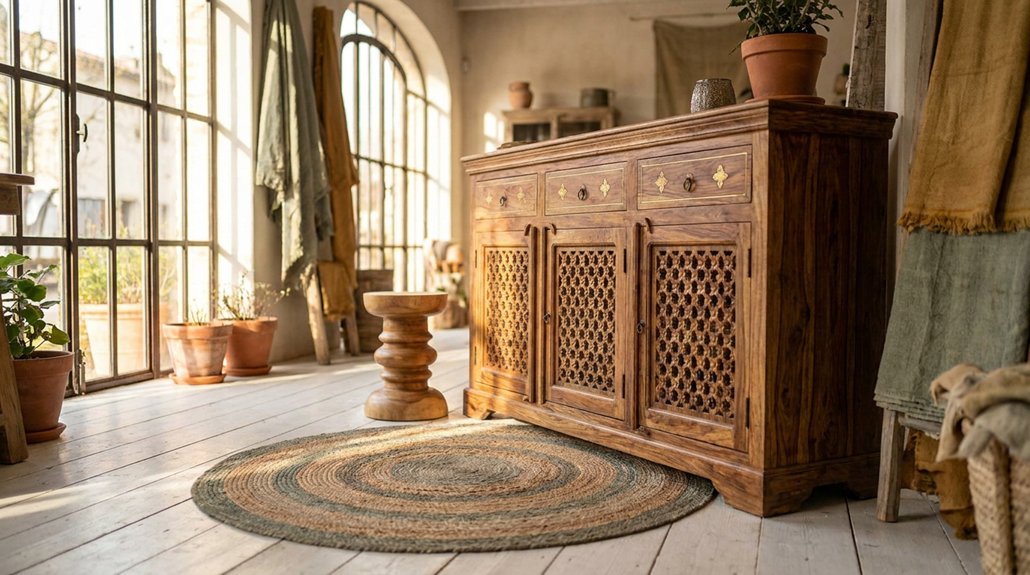
European retailers are moving handmade solid wood furniture orders from China to India, and they are keeping Chinese factories for high-volume lines. Indian suppliers deliver handcrafted pieces at landed costs 5-15% below Chinese quotes. Skilled workshop labor in India costs $7-11 per day, and skilled labor in Guangdong costs $18-30 per day. Indian workshops accept 50-100 pieces per design, and Chinese factories require 300 or more pieces per design. Buyers who plan 15-20 week lead times and budget for stricter compliance checks capture these savings.
Lower minimum order quantities let buyers test a design in one market before committing to a full container. A retailer who orders 80 pieces of a new dining table from an Indian workshop carries far less inventory risk than a retailer who orders 300 pieces from a Guangdong factory.
The cost advantage shrinks on uniform, high-volume furniture. Chinese factories use automated lines to produce identical pieces faster and with tighter dimensional tolerances than Indian workshops can match by hand. Indian lead times of 15-20 weeks also exceed the lead times for many standard Chinese catalog items, so retailers cannot use India for fast replenishment.
Compliance checks take more time with Indian suppliers. Buyers must verify timber origin documentation, finish and adhesive chemical content, and packaging treatment before each shipment. Missing paperwork can hold a container at an EU port and erase the 5-15% cost advantage.
Why Are Retailers Moving From China to India?
European retailers are moving part of their sourcing from China to India for three reasons: Chinese trade and freight costs have become unpredictable, EU due diligence rules require supplier verification, and Indian workshops produce solid-wood, hand-finished furniture that Chinese factories rarely match.
Most programs start by moving 15-30% of volume to India. Retailers keep China for upholstery, metal frames, and high-volume flat-pack lines. A full switch rarely works, because Indian workshops lack China’s component supply base.
Trade tensions make Chinese supply chains less predictable
Trade tensions raise landed costs on Chinese goods and make delivery dates harder to hold. Tariff changes, customs rule updates, and Red Sea rerouting have pushed buyers to spread orders across more than one country.
Rerouting around the Cape of Good Hope added 10-14 days to Asia-Europe sailings. Container rates from Shanghai to Northern Europe rose from roughly $1,500 to over $5,000 per 40-foot container during 2024.
India doesn’t remove this risk completely. Containers from Nhava Sheva also pass through the Suez route, so diversification lowers country risk but not route risk. Buyers who order from India still need to plan buffer stock for the same freight disruptions.
Due diligence rules push European retailers toward traceable production
European due diligence rules require retailers to verify working conditions at the sites that make their products. The German Supply Chain Act, the EU Corporate Sustainability Due Diligence Directive, and the EU Forced Labour Regulation (applying from December 2027) all put the verification duty on the buyer.
Retailers can meet that duty more easily in Indian artisan clusters such as Jodhpur and Saharanpur. These clusters contain workshops of 20-150 workers, and an auditor can walk through every production stage in one visit.
Subcontracting is the main limitation. Indian workshops often send carving or polishing work to home-based artisans. Buyers must require written disclosure of every subcontractor and audit those sites too. An audit that covers only the main workshop doesn’t satisfy due diligence.
Indian artisan clusters produce solid wood furniture that factory output can’t match
Indian workshops build furniture from solid sheesham and mango wood, with hand-carved details and hand-applied finishes. Chinese factories mostly use veneered engineered board or imported timber for the same price points, so a buyer who wants solid wood and visible craftsmanship gains a clear difference from generic ranges.
Buyers can also check joinery quality by examining drawer corners and frame connections, since mortise-and-tenon joints are robust connections that excel in chair and table frames and indicate high-quality furniture.
Three constraints apply:
- CITES permits: Sheesham (*Dalbergia sissoo*) falls under CITES Appendix II, so each shipment needs export permits and extra paperwork time.
- Drying: Mango wood is softer than sheesham and cracks if the kiln-drying is incomplete. Buyers should specify 8-10% moisture content for homes with central heating and test it on arrival.
- Finish consistency: Hand finishing varies between pieces. Buyers should approve a physical sample and set an acceptable color tolerance in the purchase order.
Costs stay competitive, but lead times and component supply need planning
Lower labor costs in India offset longer lead times and allow smaller minimum orders. Production typically takes 60-90 days in India, compared with 40-60 days in China.
Ocean transit from Nhava Sheva to Rotterdam adds 3-5 weeks. Indian workshops commonly accept 50-100 pieces per design, while Chinese factories often require a full 40-foot container per design.
Hardware is the weak point. Hinges, drawer slides, and fittings are frequently imported from China, which adds cost and delay. Buyers should confirm the hardware source before placing an order.
Buyers should also schedule inspections at about 30% of production and again before loading, because quality problems cost more to fix after shipment.
Supplier concentration falls in measurable steps. A retailer that sources 90% from China and moves 20% of volume to India drops its single-country share to 70%.
First step for buyers
Buyers should start with one category, such as solid wood dining tables, and place one trial container order with a workshop that has passed a full audit, including subcontractors.
Buyers should review the results of that order (defect rate, lead time against plan, CITES paperwork time) before moving more volume.
How Does Indian Furniture Cost Compare to China’s?
Indian furniture lands 5-15% cheaper per unit than Chinese furniture for solid-wood and handcrafted pieces when you compare total landed cost at a European port such as Rotterdam. Chinese furniture stays cheaper for upholstered, flat-pack, and MDF products, especially above about 500 units per SKU.
Landed cost means ex-factory price, inland haulage, ocean freight, import duty, and defect losses added together.
How Labor Cost Affects Indian Furniture Prices
Indian workshops pay less for skilled hand labor than Chinese factories do. Carpenters and carvers in Saharanpur and Jodhpur earn about ₹600-900 per day ($7-11), while furniture workers in Guangdong earn about $18-30 per day.
Carpenters in Saharanpur and Jodhpur earn about $7-11 a day, while Guangdong furniture workers earn $18-30.
Labor makes up a larger share of the price on carved, inlaid, and joinery-heavy pieces, so the gap grows on those items. It shrinks on CNC-cut panel furniture, where Chinese automation cuts labor hours per unit.
How Material Sourcing Affects Furniture Cost
Indian factories buy sheesham and mango wood from domestic suppliers, which avoids import costs on the main timber. Chinese factories import much of their oak, walnut, and rubberwood, and they often build with veneer over MDF to control cost.
Solid sheesham holds up better than thin veneer under daily use. Indian solid wood has a limit: it cracks or warps in transit if the kiln-dried moisture content runs above 10-12%. Require a moisture meter reading on every batch before loading.
How Import Duties Change the Landed Cost
Import duties favor India mainly in the US market, not in Europe. The US applies Section 301 tariffs of up to 25% on many Chinese furniture lines, plus anti-dumping duties on Chinese wooden bedroom furniture.
The EU charges 0-5.6% on most furniture, depending on the HS code, and applies that rate to Indian and Chinese goods alike. For Rotterdam shipments, duty rarely decides the price gap, so check the HS code of each product before you assume a duty advantage.
How Production Scale Limits the Indian Price Advantage
Chinese factories produce large volumes faster than Indian workshops. A Chinese factory typically completes a 40-foot container order in 30-45 days. An Indian workshop typically needs 60-90 days and can’t add shifts quickly.
A late Indian order forces expedite fees or a missed selling season, and either one wipes out the 5-15% saving. Place Indian orders 4-5 months before the required delivery date.
How Freight Costs Compare Between India and China
Freight from Mundra or Nhava Sheva to Rotterdam usually falls within 10% of the Shanghai-Rotterdam rate per 40-foot high-cube container, so freight rarely closes the price gap. Indian ports have the shorter transit, about 20-28 days against 30-40 from Shanghai.
Red Sea and Cape of Good Hope diversions can raise India-Europe rates sharply, so get a current quote for each shipment instead of reusing an old figure.
How to Compare Suppliers on Landed Cost
Calculate landed cost per unit for each supplier before you place an order. Add the ex-factory price, inland haulage to port, ocean freight divided by units per container, import duty, and a defect allowance.
Use a 3-5% defect allowance for Indian solid wood and 1-3% for Chinese production unless the supplier’s inspection history shows otherwise. Request a pre-shipment inspection from both suppliers so the defect figures rest on measured results.
Confirm that a delivered piece will fit through the buyer’s entrance by checking delivery dimensions against doorways and hallways, since a mismatch can cause costly installation problems.
What Makes Handmade Indian Furniture Different?
Handmade Indian furniture differs from factory-made imports because artisans cut, join, carve, and finish each piece by hand, and this produces solid-wood construction that a buyer can repair and refinish. Our workshops build with sheesham and mango wood, and production takes 8-12 weeks per order.
Artisans in Rajasthan and Saharanpur learned joinery from older family members and apply the same mortise-and-tenon methods today. Saharanpur carvers cut patterns directly into solid sheesham panels, so the carving is part of the board and cannot peel off like an applied moulding. Traditional furniture also relies on dovetail joints and hand-carved details, which reflect the same craft values that European buyers associate with durable, heritage-quality pieces.
| Factor | Handmade Indian | Factory-made Chinese |
|---|---|---|
| Construction | Mortise-and-tenon joinery | Screws, staples, glue |
| Variation | Each piece differs in grain and tone | Uniform output |
| Repairability | Can be sanded and refinished | Often cannot be repaired |
| Lead time | 8-12 weeks | 4-6 weeks |
Retailers gain a clearer selling position with handmade Indian furniture. Mass-produced imports compete on price alone, while handmade pieces let a retailer compete on solid-wood construction, visible joinery, and repairability. European shoppers pay more for furniture that looks distinctive and lasts decades.
Handmade production has three limits that retailers must plan for:
- Lead time: Handmade orders take 4 weeks longer than factory orders, so retailers should place stock orders at least 12 weeks before the selling season.
- Variation: Sheesham ranges from golden to dark brown within a single batch, so a delivered unit will not match the sample photo exactly.
- Wood hardness: Mango wood is softer than sheesham, so mango tabletops show scratches sooner.
Retailers should state the variation and hardness differences on product pages and in sales conversations before the customer orders. This prevents returns caused by mismatched expectations.
Which Indian Woods and Crafts Sell in Europe?
Which Indian Woods and Crafts Sell in Europe?
Four Indian woods sell consistently in Europe: teak, mango, sheesham, and rosewood. European buyers choose among them based on use (indoor or outdoor), price, and paperwork requirements.
- Teak: Teak resists moisture and insects, so garden and dining buyers choose teak tables and benches that need little maintenance. Teak suits outdoor ranges. Request plantation-origin documents from your supplier for every teak order.
- Mango: Mango costs less than the other three woods. Mills source mango from orchard trees that no longer produce fruit, which gives buyers a clear sustainability story. Mango has a warm, varied grain. We kiln-dry mango to 8–10% moisture content for centrally heated European homes. Mango is softer than teak and sheesham, so use mango for indoor furniture only.
- Sheesham: Sheesham carries deep carving well. Our carvers cut jali screens and build inlaid cabinets from sheesham, and mass-produced imports can’t match this work. Sheesham is a Dalbergia species, so check its current CITES listing and annotation before each order.
- Rosewood: Rosewood sells at premium prices. Indian rosewood is a Dalbergia species under CITES Appendix II, so every EU shipment needs an export permit from India and an import permit from the destination country. Obtain both permits before shipment. Customs holds shipments without them.
Start with mango and sheesham for volume, because both woods have lower unit costs and steady demand.
Add teak when you build an outdoor range.
Sell rosewood as a small, high-margin line, since permit costs and lead times limit rosewood volume.
We document origin and finishing on every order, which clears customs and answers buyers who ask where their furniture comes from.
What Do Retailers Gain From Sourcing in India?
What Do Retailers Gain From Sourcing in India?
European retailers gain four things from sourcing handmade furniture in India: a range that competitors can’t copy with machine output, labor and material records that auditors can verify, products with a story customers can repeat, and lower demand on native forests. We build sheesham and mango wood furniture in Indian workshops. A 40-foot container typically holds 200 to 350 case pieces, depending on size. Production takes 60 to 90 days, and sea freight to Rotterdam or Hamburg takes another 25 to 35 days. Each gain below comes with a limit you should plan for.
Artisan Craftsmanship Differentiates Your Range
Indian carvers differentiate your range by cutting detail by hand that factory lines in China don’t reproduce. A carved sideboard front takes a carver several days with chisels and gouges, while a CNC router finishes a comparable pattern in minutes. Shoppers can see the difference in chisel marks and uneven depth, and many pay a higher price for it.
Hand carving produces small variations between pieces. Your buyer must approve a sample and a written tolerance range before production starts. Capacity is also limited. A single workshop employs a fixed number of carvers, so a repeat order of 500 or more units requires us to split production across several workshops and check consistency on each batch.
Small Workshop Clusters Make Ethical Sourcing Easier to Document
Small workshop clusters let your auditors verify labor conditions and material origin in person. Furniture production in cities such as Jodhpur and Saharanpur concentrates carvers, joiners, finishers, and timber suppliers within a few kilometers.
Our team visits each workshop and records headcount, wages, working hours, and the timber supplier for every order. You see the whole chain from one location instead of tracing it across several layers of intermediaries.
Subcontracting is the main weakness. Some carving and finishing work goes to home-based workers who aren’t listed on the factory register. Write a subcontractor disclosure clause into your purchase contract. Request the latest third-party audit report (SMETA or amfori BSCI) from every supplier, and read the audit date, because a report older than 12 months doesn’t describe current conditions.
Indian Motifs and Finishes Give Customers a Story
Indian motifs and finishes give your sales staff a specific story to tell at the point of sale. Brass inlay, jali lattice panels, hand-rubbed oil finishes, and whitewashed distressing each come from a named technique and region. Customers who ask where a piece comes from receive a concrete answer.
The story must be accurate. A piece made with machine-cut parts can’t be labeled “handmade,” and your product cards should state the cluster, the technique, and the wood species. Taste also varies by market. A finish that sells in Germany may not sell in France, so test a collection of 10 to 15 SKUs in two or three stores before you commit to a full range.
Plantation Wood and Certified Supply Reduce Pressure on Native Forests
Plantation, reclaimed, and FSC-certified wood reduces the volume of timber cut from native forests. Sheesham comes mostly from farm and plantation stands, and mango wood comes from orchard trees that growers fell once fruit yields decline.
We kiln-dry all timber to 8 to 12 percent moisture for European indoor use, which also prevents cracking in heated homes.
Not all Indian timber is certified. Demand the FSC certificate code, verify the code in the FSC public database, and request a chain-of-custody invoice for each shipment. The EU Deforestation Regulation also requires geolocation data and due diligence statements for wood products, so ask your supplier for plot-level origin records before the first order ships.
How to Start
Start with one container, one cluster, and one collection. Review the first quality-control cycle, the audit documents, and the certificate checks, then expand volume once those results meet your standards.
Which MOQ, Lead Time, and Compliance Hurdles Matter?
Which MOQ, Lead Time, and Compliance Hurdles Matter for a First Order?
Three hurdles decide whether a first order from an Indian workshop ships on time and on budget. Minimum order quantity (MOQ) runs 50–100 pieces per design. Lead time totals 15–20 weeks, split into 10–14 weeks of production and 5–6 weeks of sea freight. Compliance requires EUDR, REACH, and, for some products, CE documentation.
MOQ
Indian workshops set MOQ per design, typically at 50–100 pieces. Large Chinese factories usually require 300 or more. A lower MOQ lets you test 3–4 designs without committing capital to one.
Orders below 50 pieces per design usually raise the unit price, because the workshop still has to set up jigs, mix finishes, and cut wood for a short run. Ask each workshop whether its MOQ applies per design, per finish, or per order, since the definition changes the total quantity you must buy.
Lead time
Production takes 10–14 weeks, and sea freight adds 5–6 weeks, so goods reach a European port 15–20 weeks after you confirm the order. Place the order before the workshop’s peak season, because a full production schedule pushes your start date back.
Add a buffer for the monsoon (June–September). Humidity slows wood drying and lacquer curing, and heavy rain delays trucking to the port. Write the production start date, the inspection date, and the shipping date into the purchase order.
Compliance
Compliance documents cause more shipment delays than MOQ or lead time. EUDR (the EU Deforestation Regulation, which replaces the EU Timber Regulation) requires proof that the wood is legally harvested and deforestation-free. REACH restricts hazardous chemicals in finishes and lacquers. CE marking applies only to products covered by a specific EU directive, such as lamps with electrical parts.
Missing or incomplete paperwork stalls shipments at customs. Request these documents from the supplier before you pay a deposit:
- FSC chain-of-custody certificate, with the certificate number
- Wood species and origin records that support the EUDR due diligence statement
- REACH declaration or test report for each finish and lacquer
- CE documentation for any product that falls under a CE directive
An FSC certificate alone doesn’t satisfy EUDR, so confirm that the supplier can also provide origin data for the wood. After you collect the documents, inspect a pre-production sample, confirm packaging specifications, and fix the timeline in writing. These steps protect your margin by preventing rework, demurrage, and customs holds.
How Do You Vet an Indian Furniture Supplier?
Vetting an Indian furniture supplier takes four checks: registration and export history, factory verification, quality assurance, and a paid sample run. We complete these in 4 to 8 weeks before we place a first container order of 40 to 60 cubic meters.
Check Registration and Export History
We confirm the supplier’s legal status by requesting the Importer Exporter Code (IEC) and the GST certificate. We verify the IEC on the DGFT portal and the GST number on the government GST portal.
Next, we ask for bills of lading from at least three shipments to Europe in the past 24 months. We contact two European clients and ask about lead time accuracy, defect rates, and claim handling.
These certificates prove registration only. Trading companies hold the same IEC and GST documents as factories, so we ask directly whether the supplier owns the production site.
Verify the Factory
We ask the supplier for a live video walk-through instead of an edited promotional video. The walk-through must show the kiln, the machine shop, the finishing line, and the packing area.
We request timber purchase invoices and, where the state requires them, transit permits for sheesham and mango logs. We compare the supplier’s stated headcount against payroll or provident fund records.
As a rough benchmark, a workshop of 60 skilled workers makes 2 to 3 forty-foot containers of solid wood furniture per month. A supplier who claims 10 containers with that headcount is subcontracting, and we ask who the subcontractors are.
Control Moisture and Quality
We ask the supplier to document moisture control, because kiln-dried sheesham and mango wood at 8 to 10 percent moisture content resists warping in centrally heated European homes. Air-dried timber at 14 to 18 percent cracks and twists during the first heating season.
We request kiln logs for each batch and check the boards ourselves with a pin moisture meter. We also request a written inspection protocol that states the sampling standard, such as AQL 2.5, and the checkpoints for incoming timber, assembly, and finishing.
Before any order larger than one container, we commission a third-party audit from SGS or Bureau Veritas. An audit typically costs USD 500 to 900 per auditor day.
Run a Paid Sample
We pay for a pre-production sample so the supplier treats the sample as a real order. When the first shipment arrives, we compare randomly chosen pieces against the sample for dimensions, joint construction, finish color, and weight.
Consistency across 200 pieces matters more than one perfect piece, because a buyer sells the whole container, not the best chair in it. A supplier that can’t reproduce its own sample is a supplier we drop.
Test Communication
A reliable supplier answers technical questions within 24 hours and reports delays before we ask. We test this during sampling by asking about veneer thickness, hardware origin, and packing specifications.
If the supplier gives vague answers or reports problems only after we chase, we end the relationship. Restarting with a new supplier costs 4 to 6 weeks. A container of warped tabletops costs far more.