

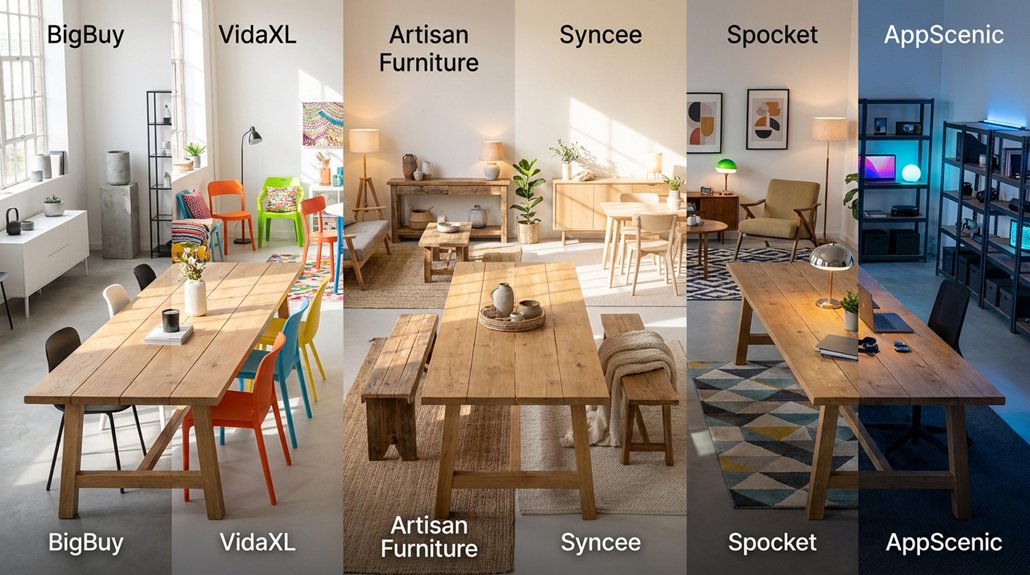
In this 2026 comparison, we analyze BigBuy, VidaXL, Artisan Furniture, Syncee, Spocket, and AppScenic to determine the best dropshipping suppliers for furniture. We assess catalog depth by style and price range, measure profit margins after shipping and fees, and evaluate delivery performance in the EU, UK, and US, including damage rates and return processes. We also examine branding options and the reliability of automation tools to minimize risks and prevent overselling. This analysis helps us identify the most suitable partner for specific store models.
Catalog Depth Analysis
BigBuy offers a wide range of furniture styles and price points, while VidaXL focuses on budget-friendly options. Artisan Furniture specializes in high-quality, handcrafted items, making it ideal for niche markets. Syncee provides a robust catalog with a blend of styles, and Spocket emphasizes North American suppliers. AppScenic features a diverse selection, appealing to various customer preferences.
Profit Margin Evaluation
We calculate profit margins for each supplier after accounting for shipping and fees. BigBuy generally provides competitive margins, while VidaXL’s low-cost items may attract high-volume sales despite thinner margins. Artisan Furniture’s unique products can command higher prices, but margins vary by item. Syncee and Spocket offer balanced options, while AppScenic’s margins depend on the specific suppliers chosen.
Delivery Performance Assessment
We stress-test delivery capabilities for each supplier in the EU, UK, and US markets. BigBuy consistently meets delivery timelines, while VidaXL experiences occasional delays. Artisan Furniture maintains a track record of reliable shipping for premium products. Syncee and Spocket ensure timely deliveries, but performance varies by supplier. AppScenic’s delivery success depends on the chosen vendors.
Damage Rate and Returns Analysis
We track damage rates during transit and the efficiency of return processes. BigBuy shows a low damage rate, contributing to customer satisfaction. VidaXL faces challenges with damaged items, impacting returns. Artisan Furniture’s premium packaging reduces damage risk. Syncee and Spocket handle returns effectively, while AppScenic’s return process varies by supplier.
Branding Options and Automation Reliability
We evaluate branding opportunities and automation reliability across suppliers. BigBuy provides strong branding capabilities, enabling customization. VidaXL offers limited branding options, while Artisan Furniture allows for unique branding on handcrafted items. Syncee and Spocket excel in automation, reducing manual tasks. AppScenic’s automation varies by supplier, impacting overall efficiency.
Final Decision-Making
By synthesizing data on catalog depth, profit margins, delivery performance, damage rates, returns, branding options, and automation reliability, we can select the best dropshipping partner for specific furniture store models. This analysis focuses on practical metrics to inform strategic decisions, ensuring reliable partnerships in the furniture dropshipping landscape.
How to Pick a Furniture Dropshipping Partner in 2026
In 2026, selecting a furniture dropshipping partner requires a structured, data-driven approach. Start by identifying your target segment. Analyze how a potential supplier’s catalog, styles, and pricing align with current market trends and customer preferences. Quantify this alignment by assessing SKU overlap with your business strategy, historical pricing volatility, and how often the supplier refreshes their product portfolio.
Next, evaluate operational reliability. Gather data on on-time delivery metrics, average handling times, damage rates, return rates, and stockout frequencies for each SKU. Ensure you receive service-level agreements in writing.
Create models to simulate worst-case scenarios, including delayed shipments, seasonal demand spikes, and unexpected carrier fees.
Assess the supplier’s technology and data accessibility. Confirm that they offer real-time inventory tracking, order webhooks, or APIs. Make sure they maintain clear product data standards.
Finally, stress-test the unit economics. Conduct landed-cost simulations that include shipping, packaging, payment fees, and projected return rates. Understanding the impact of solid wood furniture on customer satisfaction can enhance your decision-making process.
These calculations help you understand the financial implications before finalizing your partnership.
BigBuy, VidaXL, Artisan, Syncee, Spocket and AppScenic at a Glance
In 2026, six platforms dominate the furniture dropshipping market: BigBuy, VidaXL, Artisan, Syncee, Spocket, and AppScenic. Each platform serves a specific role in logistics, technology, and brand positioning. To effectively navigate this landscape, we must assess supplier strengths, automation capabilities, and geographic reach.
| Focus Area | Quick Take |
|---|---|
| Logistics & SLAs | BigBuy and VidaXL excel in EU warehousing, offering reliable trackable shipping and strong service level agreements (SLAs). |
| Tech & Workflow | Syncee, Spocket, and AppScenic prioritize app ecosystems and automation for streamlined operations. |
| Brand Positioning | Artisan focuses on delivering higher perceived value and enhancing storytelling opportunities for brands. |
Evaluate Platforms as Operational Partners
We must consider each platform as an operational partner rather than merely a product list. This evaluation involves assessing order synchronization reliability, stock update frequency, chargeback exposure, and return handling processes. By mapping these variables, we can establish scalable processes that enhance customer experience while minimizing margin risks.
- Logistics & SLAs: Assessing BigBuy and VidaXL
- BigBuy and VidaXL provide robust EU warehousing options. They ensure reliable trackable shipping, which is critical for customer satisfaction. Their SLAs offer clear expectations for delivery timelines.
- Tech & Workflow: Analyzing Syncee, Spocket, and AppScenic
- Syncee, Spocket, and AppScenic emphasize integrating app ecosystems. Their automation features streamline product sourcing and order processing, which reduces manual workload and improves efficiency.
- Brand Positioning: Understanding Artisan’s Strategy
- Artisan positions itself to cater to brands seeking higher perceived value. This focus allows businesses to leverage storytelling opportunities, enhancing brand loyalty and customer engagement.
Conclusion: Focus on Operational Efficiency
To optimize our dropshipping operations, we should continuously evaluate each platform’s logistics, technology, and brand strategies. Understanding these factors will help us build efficient processes that meet customer needs while controlling costs and risks. Additionally, maintaining a cohesive look with aesthetic cohesion in furniture can enhance brand appeal and customer satisfaction.
Catalog Depth: Furniture Styles, Price Points and Niches
When evaluating catalog depth across furniture dropshipping platforms, we need to assess style coverage, price bands, and niche segments.
We’ll quantify each supplier’s SKU count per style and price band, specifically looking at styles like Scandinavian, industrial, mid-century, farmhouse, contemporary, and luxury. We’ll also categorize price bands into entry, mid-market, and premium. Additionally, we’ll identify niche segments such as space-saving, outdoor, office, kids, eco-friendly, and made-to-order.
BigBuy and VidaXL typically offer a vast range of SKUs, but this breadth can weaken their focus in competitive niche markets. Artisan Furniture specializes in curated mid- to premium pieces, demonstrating stronger depth in specific aesthetics rather than lower-priced options.
Syncee, Spocket, and AppScenic rely heavily on the brands we onboard. This often leads to uneven catalog depth, particularly in kids’ and eco-friendly categories.
Our challenge is to avoid assortment gaps; for instance, we may rank well for “industrial sideboards” but lack complementary coffee tables or chairs.
To ensure comprehensive coverage, we’ll continuously monitor SKU counts and assess how well each supplier aligns with current trends and timeless pieces.
This approach helps us maintain a competitive edge and meet diverse consumer needs effectively.
EU, UK and US Shipping for Furniture Dropshipping
As we evaluate furniture dropshipping suppliers, we must prioritize EU, UK, and US shipping as a critical operational factor. Large, bulky furniture items intensify challenges in international logistics. Issues such as longer transit times, higher damage rates, missed delivery windows, and complicated returns become more pronounced with furniture shipments.
We need to analyze where each supplier maintains stock, including EU hubs, UK warehouses, and US fulfillment centers. Understanding their logistics involves identifying the carriers they partner with and reviewing average delivery service level agreements (SLAs) by country.
Consolidated European warehouses can reduce cross-border complications, but UK deliveries post-Brexit often require additional checks and paperwork.
We must gather specific data on shipping costs, including volumetric pricing, surcharges for oversized parcels, residential delivery fees, and costs for remote areas. Offering white-glove service or room-of-choice delivery can enhance the customer experience for high-ticket items, but only if these options are consistently available and trackable.
Next, we should verify each supplier’s damage and loss rates, claims procedures, and policies for reshipping when large items arrive damaged or defective. This information is critical for managing customer expectations and ensuring smooth operations.
Pricing Models, Profit Margins and Hidden Fees
Pricing Models, Profit Margins, and Hidden Fees in Furniture Dropshipping
Furniture dropshipping partnerships hinge on three key factors: the supplier’s pricing model, achievable profit margins, and hidden fees.
To evaluate a supplier effectively, we must analyze their pricing structures in detail and derive predictable unit economics.
Calculate Landed Cost per SKU
First, calculate the landed cost per SKU. This cost includes wholesale price, shipping fees, and any mandatory surcharges.
Then, set target margins: aim for 35–50% on mid-ticket furniture and 20–30% on bulky or heavy items. Margins below these thresholds make scaling through paid traffic difficult.
Model Per-Supplier Scenarios
Next, model scenarios for each supplier. Break down costs per SKU at three to four price points: entry, mid, and premium.
Analyze how order volumes affect pricing, consider currency fluctuations, and assess the impact of dynamic repricing on profit.
Evaluate how return rates and damage allowances influence overall profit margins.
Ensure Fee Transparency
Fee transparency is essential. Identify and disclose all handling, storage, data-access, and payment fees upfront.
Failure to do so risks margin erosion after launch.
Conclusion
Focus on these elements: calculate landed costs, model price scenarios, and ensure fee transparency.
This structured approach leads to informed decisions and sustainable dropshipping partnerships in the furniture industry.
Branding, White-Label and Packaging Options
Audit Supplier Branding, White-Label, and Packaging Options
To support premium pricing, we must audit supplier branding, white-label, and packaging options rigorously. We focus on three specific criteria: the ability to ship under our brand name, control over inserts and labeling, and packaging innovations that minimize damage rates and returns.
Evaluate White-Label Support
Artisan Furniture provides comprehensive white-label support and ensures a premium unboxing experience. This makes Artisan Furniture suitable for high-ticket branding strategies.
> Artisan Furniture’s full white-label support delivers a premium unboxing experience ideal for high-ticket branded collections.
In contrast, BigBuy and VidaXL use neutral or supplier-branded packaging. While this approach works for budget positioning, it undermines long-term brand equity.
Assess Packaging Options for Supplier Dependence
Spocket, Syncee, and AppScenic depend on their underlying suppliers for branding options.
We need to filter vendors based on three criteria: logo placement rules, carton neutrality, and the availability of branded inserts or stickers. This ensures we maintain control over our brand presentation.
Track Key Metrics for Supplier Packaging
We must monitor specific metrics across all six suppliers.
These metrics include the branded-order penetration rate, damage and return percentages linked to supplier packaging specifications, and customer reviews that mention packaging or presentation.
Automation, App Integrations and Inventory Sync
When we evaluate furniture dropshipping suppliers, we prioritize automation, app integrations, and inventory sync as essential risk controls. A single oversold SKU can eliminate an entire week’s profit at furniture price points, so we closely examine how each platform manages stock levels, pricing, and order routing.
We focus on three key questions: How often does inventory sync run? How many platforms can we connect, such as Shopify, WooCommerce, and various marketplaces? What measures are in place to address API delays or failures?
Consider the scenario when a product trends:
- Orders surge from multiple channels within minutes.
- Real-time inventory management ensures we don’t sell units that the supplier no longer has in stock.
- Automated order forwarding and tracking updates allow us to concentrate on merchandising and ad performance.
Suppliers that offer rule-based mapping, multi-warehouse logic, and transparent sync logs significantly reduce operational risk and enhance predictability during scaling.
Returns, Damages and After-Sales Support for Furniture Orders
We evaluate service level agreements (SLAs) for first response times across support channels: email, live chat, phone, and ticket systems. A 24–48 hour delay in addressing a damaged $800 sofa can significantly erode customer trust and negatively impact review scores.
We collect and analyze customer feedback on each supplier. This includes tracking the frequency of transit damage, the rate of claims denial, the average time to issue refunds or replacements, and whether suppliers proactively reship items or require returns before issuing replacements.
We closely track supplier performance on transit damage, claims outcomes, refund speed, and proactive replacement practices
Effective after-sales support relies on structured workflows and clear documentation requirements. We integrate these elements into our store policies and communicate them during the pre-sale process.
We prioritize timely and effective communication to enhance customer satisfaction. By establishing clear timelines for responses and resolutions, we can manage customer expectations better. This approach helps us maintain a positive relationship with our customers and ensures they feel supported after their purchase.
Best Furniture Dropshipping Partner by Store Type and Budget
After evaluating how each supplier manages returns and damage claims, the next step is to select the best dropshipping partner that aligns with your store type and budget.
Focus on key metrics: average item cost, shipping fees, margin potential, and catalog depth for both affordable and luxury options.
For budget-focused general home stores, VidaXL and BigBuy lead in SKU volume and price flexibility.
For design-oriented boutiques, Artisan Furniture offers a curated selection that often justifies its higher average order values and stricter onboarding process.
To make this actionable, let’s categorize by store profile:
- Lean startup on a tight budget: Choose VidaXL, BigBuy, or Syncee for low minimum order quantities (MOQs) and a wide range of affordable products.
- Mid-market lifestyle brand: Combine Spocket or AppScenic with select mid-range European suppliers to balance quality and pricing.
- Premium design studio: Focus on Artisan Furniture and vetted Syncee vendors that provide consistent luxury offerings and documented quality control processes.