

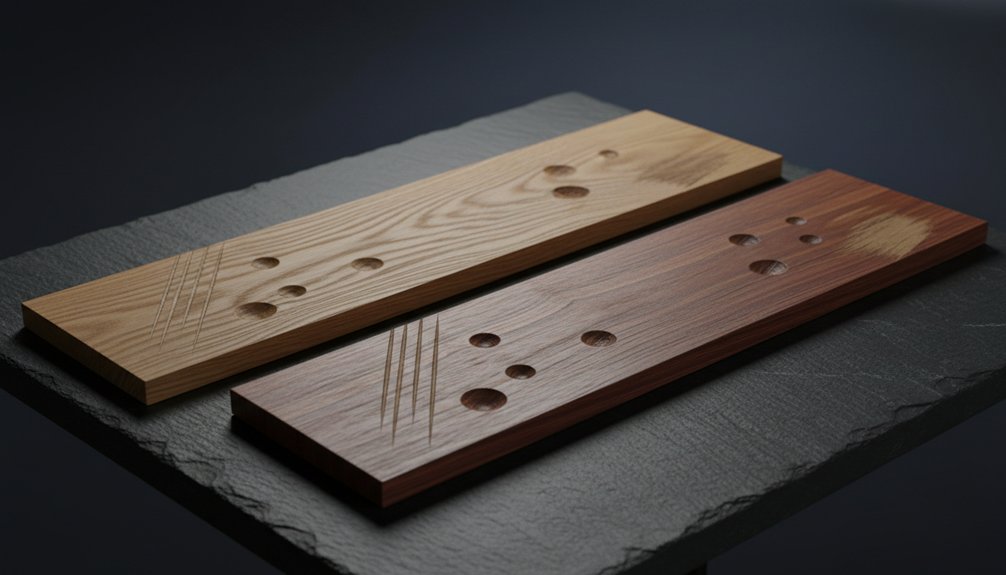
When comparing the durability of oak and cherry wood, consider the following key points. Oak has a higher Janka hardness rating of 1,290, which indicates that it resists scratches and dents better than cherry’s rating of 950. This makes oak a superior choice for high-traffic areas where wear and tear is a concern.
Oak’s dense grain allows it to endure aggressive refinishing every 10 to 15 years, while cherry requires more gentle care with refinishing needed every 7 to 10 years. However, cherry wood excels in maintaining dimensional stability in varying humidity levels, resulting in less warping compared to oak.
Cost-wise, cherry wood typically comes with a higher price tag, ranging from 15 to 30% more than oak. Yet, oak generally incurs lower long-term maintenance costs due to its durability.
In summary, if you prioritize scratch resistance and long-term maintenance, choose oak. If you need wood that performs well in humid conditions and you can invest more upfront, cherry is the better option. Understanding these factors will guide you in making an informed decision based on your specific needs.
Understanding the Janka Hardness Scale for Wood Comparison
When you need to evaluate the durability of wood types, you rely on the Janka hardness scale. This scale measures the force required to embed a small steel ball halfway into a wood sample. Higher Janka numbers indicate harder wood, which means better resistance to dents and wear.
The Janka hardness rating guides your material selection for various projects. For instance, when installing flooring in high-traffic areas, you should choose woods with higher Janka ratings. The test provides resistance measurements in pounds-force, allowing for straightforward comparisons.
Higher Janka ratings indicate superior durability for flooring in high-traffic areas, measured objectively in pounds-force for easy comparison.
You can analyze how oak and cherry compare by looking at their Janka ratings. This objective measurement streamlines your wood selection process and eliminates uncertainty.
Understanding the Janka hardness scale helps you choose the right wood for your specific needs. By focusing on these ratings, you can ensure that your materials will withstand daily use and maintain their appearance over time.
Density and Grain Structure Differences Between Oak and Cherry
The cellular structure of wood directly impacts its strength and performance.
Oak has a dense, open-grain structure with visible pores, which enhances its resistance to impact damage. Oak‘s density ranges from 37 to 56 pounds per cubic foot, depending on the species. This density contributes to oak’s mechanical strength, making it suitable for high-impact applications.
In contrast, cherry has a fine, closed-grain structure with minimal visible pores. This tighter grain creates a smoother surface, which is ideal for detailed woodworking projects. However, cherry’s impact resistance is slightly lower than that of oak. Cherry’s density falls between 35 to 43 pounds per cubic foot, making it lighter than oak.
Overall, oak’s coarser texture provides strength for demanding uses, while cherry’s uniform grain allows for easier shaping and finishing.
Both woods serve distinct purposes based on their structural characteristics, and understanding these differences is crucial for selecting the right material for your project.
Resistance to Scratches, Dents, and Daily Wear
When comparing oak and cherry wood, you’ll find clear differences in their performance against everyday wear and tear.
Oak has a Janka hardness rating of 1,290, making it more resistant to scratches than cherry, which has a rating of 950. This higher hardness level helps oak better resist dents, especially in busy areas of the home.
Key Performance Factors:
- Impact Protection – Oak absorbs impacts from dropped objects better than cherry, leading to fewer visible dents from everyday accidents.
- Surface Durability – The softer nature of cherry makes it more vulnerable to damage from pet claws and furniture movement.
- Long-term Appearance – Oak retains its original finish longer during regular use compared to cherry.
When choosing wood for flooring or furniture, consider how active your household is.
Oak is the better choice for homes with children and pets due to its durability. Cherry, on the other hand, suits low-traffic areas where careful handling of heavy items is more likely.
Moisture Resistance and Dimensional Stability
When you choose between oak and cherry for your home, consider how each wood responds to changes in moisture.
Oak absorbs water faster than cherry, which causes oak to swell more during humid months. In contrast, cherry absorbs moisture more slowly and expands less.
During dry periods, oak shrinks more significantly, while cherry retains its shape better.
These differences in moisture resistance and dimensional stability are crucial for your flooring, furniture, and cabinetry.
If you select oak, expect more gaps and potential warping over time if humidity fluctuates. On the other hand, cherry will generally maintain its integrity and show fewer signs of damage due to moisture changes.
Understanding these characteristics will help you make a more informed choice that suits your specific environment.
Water Absorption Rate Comparison
Moisture resistance is a key factor that directly impacts wood durability. Wood exposure to water can cause warping, swelling, and decay. When comparing oak and cherry, their water absorption rates reveal important differences that affect their use in various environments.
- Initial absorption rate: Oak absorbs water 15-20% faster than cherry during the first 24 hours. This means that if you leave both types of wood in water, oak will take on moisture much more quickly.
- Long-term moisture retention: Cherry maintains more stable moisture levels over extended periods. This stability makes cherry a better choice for areas with fluctuating humidity, as it’s less likely to warp or swell over time.
- Recovery time: Cherry returns to its original dimensions faster after drying compared to oak. This property allows cherry to be more resilient in environments where moisture levels change frequently.
Understanding these specific characteristics helps you choose the right wood for applications in moisture-prone settings.
If you need wood that can handle exposure to water without compromising its shape or integrity, cherry is often the better option.
Swelling and Shrinkage Patterns
When wood gains or loses moisture, it changes size in ways that vary significantly between oak and cherry. Oak, due to its porous structure, undergoes more noticeable dimensional changes compared to cherry. For instance, red oak experiences tangential shrinkage of about 8.6%, while white oak shows approximately 9.0% shrinkage. In contrast, cherry has a tangential shrinkage of around 7.1%.
Understanding these shrinkage patterns is crucial for predicting how each wood type reacts to humidity changes. Oak’s open grain structure allows it to absorb moisture quickly, resulting in rapid expansion. Cherry, with its tighter grain, resists sudden changes, maintaining more stable dimensions.
These shrinkage effects are particularly important when working on furniture and flooring projects. When planning joints and spacing for oak, you must account for its greater movement. Cherry’s more predictable behavior makes it easier to work with across different climates, helping to ensure that your projects maintain their integrity over time.
Long-Term Performance in High-Traffic Areas
When you install hardwood floors in busy areas like hallways, kitchens, or entryways, you need strong wood that can withstand heavy foot traffic.
Oak and cherry both develop a unique look over time, but they handle wear differently. Oak is more durable and resistant to scratches and dents, making it a better choice for high-traffic areas. Cherry, while beautiful, is softer and can show wear more quickly.
To choose the right wood for your high-traffic spaces, consider how each type performs. Oak will hold up better under constant use, while cherry may require more maintenance to keep it looking good.
Assess your lifestyle and the amount of traffic your floors will face to make the best decision. If you prioritize durability, go with oak; if you prefer aesthetics and are willing to put in the effort, cherry might be your pick.
Wear Resistance Over Time
When you select flooring for areas like hallways, kitchens, or living rooms that experience heavy foot traffic, it’s important to know how oak and cherry perform over time.
Oak features a harder surface, which means that wear patterns develop more slowly. This characteristic allows oak to maintain its appearance for a longer period. In contrast, cherry has a softer composition, which makes it more susceptible to scratches and dents.
Key differences in long-term wear:
- Oak retains its finish for 10-15 years with proper maintenance, while cherry typically needs refinishing every 7-10 years.
- Cherry develops a deeper patina over time, which can help disguise minor surface imperfections.
- Oak resists indentations better than cherry, making it more durable against furniture and dropped objects.
Overall, oak flooring holds its original texture longer, making it a practical choice for environments where durability is a priority.
If you want a floor that stands up to constant use, oak is the better option.
Dent and Scratch Comparison
When selecting flooring for high-traffic areas, understanding the dent and scratch resistance of oak and cherry becomes crucial. Oak offers superior hardness, which translates to high dent resistance. This makes oak flooring suitable for busy households with pets and children. In contrast, cherry has a softer composition, leading to moderate dent resistance. This means cherry can be more susceptible to dents from dropped objects or moving furniture.
Here’s a breakdown of the properties:
| Property | Oak | Cherry |
|---|---|---|
| Janka Hardness | 1,290-1,360 | 950-995 |
| Dent Resistance | High | Moderate |
| Scratch Resilience | Excellent | Good |
In practical terms, oak retains its appearance longer in areas like hallways and kitchens that experience heavy foot traffic. Cherry, while it may require more careful handling, can develop a unique character over time through wear. Therefore, it’s important to consider your lifestyle and the level of wear and tear your flooring will face when choosing between oak and cherry for long-term performance.
Maintenance Requirements and Refinishing Capabilities
Oak and cherry wood both require regular maintenance to keep their appearance intact, but they’ve different refinishing capabilities.
Oak features an open grain structure, which means you can use more aggressive sanding techniques without risking damage to the wood. This allows for deeper refinishing cycles, making oak suitable for high-traffic areas.
Oak’s open grain structure tolerates aggressive sanding and deeper refinishing, making it ideal for high-traffic spaces.
In contrast, cherry wood has a closed grain that’s more prone to damage during refinishing. You need to be cautious and employ gentler methods when working with cherry to avoid issues like surface damage. Additionally, cherry requires specific staining techniques to prevent blotchiness when applying new finishes.
Both oak and cherry benefit from a consistent maintenance routine. You should clean both types of wood quarterly and recoat them annually to maintain their protective layers.
Understanding these maintenance and refinishing differences will help you make better decisions for the long-term care of your wood investments.
Cost-Benefit Analysis Based on Durability Factors
When selecting wood for flooring, focus on the total cost of ownership rather than just the initial purchase price. Cherry wood typically has a higher upfront cost, about 15-30% more than red oak.
However, to make a sound decision, you need to consider durability factors, including maintenance costs, refinishing needs, and replacement timelines.
Red oak has a higher hardness level, which translates to lower repair and refinishing expenses over a period of 20 to 30 years. The softer surface of cherry wood requires more frequent touch-ups, leading to increased long-term maintenance costs.
Additionally, evaluate the resale value of the flooring. Red oak tends to attract a wider range of buyers, making it a more appealing option in the long run.
When you analyze total expenses—including installation, maintenance, and potential replacement costs—red oak often emerges as the more economical choice, even if the initial prices are similar.
Ultimately, your decision should align with your specific usage patterns and traffic levels to determine which wood provides better value for your flooring project.